
These days, everyone’s confused about what healthy eggs are. A case in point:
“We’ve agreed to disagree about the kinds of eggs we buy. Whenever I go shopping, I buy the free-range kind. Whenever my husband goes, he buys the cheapest eggs he can find. I insist on buying the free-range eggs, because I know you say they’re healthier.”
“Ah, but really they’re not. At least not when it comes to supermarket eggs.” I say.
“Oh.”
Misleading Labels
You see, according to the law, “free-range” doesn’t really mean much of anything. The thing that makes eggs healthy and nutrient-dense is when hens have access to the outdoors, to sunlight, to bugs and green grass. If a label says “free-range,” it guarantees none of those things.
In fact “free-range” can simply mean that the hens have “access” to the outside for as little as five minutes a day! They may not even choose to go outside, and when they do, they may simply be walking out into a concrete slab devoid of any bugs, larvae, or grass.
A similar thing can be said for the “cage-free” label. All that means is that rather than being crammed into cages stacked on top of each other, hens are cage-free. They can still be confined indoors for their entire lives, never seeing a day of sunshine.
Even “organic” eggs only guarantee that the chicken was fed organic feed and isn’t receiving antibiotics. They could still have limited or no access to the outside, and their diet is surely unnatural.
Healthy Eggs: What To Buy
So, faced with these meaningless labels, how can you choose the most nourishing, healthy eggs for your family?
Prioritize the purchase of eggs this way:
BEST CHOICE: Pastured eggs from a local farmer (aka Real Eggs). Chickens live their entire lives outdoors, in the pasture, picking through cow dung, eating bugs and grass, basking in the sun. Their feed may or may not be supplemented with anything other than what God and Nature provide in the field. If it is supplemented, a non-soy feed is best. Pick these up at your local farmer’s markets, use Craigslist or another local ad service to find someone raising hens who would like to part with excess eggs, or even find these at the grocery store. (Here in Austin, for example, my local supermarket chain HEB carries two brands of eggs from pasture-raised hens!)
Remember, when compared to the USDA’s nutrient data for conventional eggs coming from chickens confined in factory farms, the eggs of pastured hens usually contain:
- 1⁄3 less cholesterol
- 1⁄4 less saturated fat
- 2⁄3 more vitamin A
- 2 times more omega-3 fatty acids
- 3 times more vitamin E
- 7 times more beta carotene
- 4 to 6 times more vitamin D
SECOND: At the supermarket, choose the eggs with the most Omega-3s and DHAs available. Those are the nutrients most commonly lacking in the eggs from “battery hens,” and some companies have specially formulated their chicken feed in an attempt to make up for the hen’s abnormal and unnatural living conditions.
THIRD: Organic eggs. Although they may not be nutritionally superior to your average “battery hen” eggs, you at least know these eggs came from hens raised without the use of antibiotics and that the hens were fed organic feed. So you at least won’t have any environmental guilt buying them.
For the rundown on organic supermarket eggs and how their standards are usually not worth the extra money you’re paying, read this post on Big-O Organic Eggs.
Healthy Eggs: What To Look For
Real eggs are amazing to behold. The average egg is made up of three parts you need to pay attention to:
- the yolk
- the thick egg white
- the thin, runny egg white
You can tell how nutrient-dense and healthy an egg is by appearance alone. You can tell if a farmer’s telling you the truth or scamming you. You can tell if the chicken who produced the eggs was happy or sad.
I’m not kidding.
When compared to conventional, battery hen eggs, the eggs from pastured chickens have these differences in appearance:
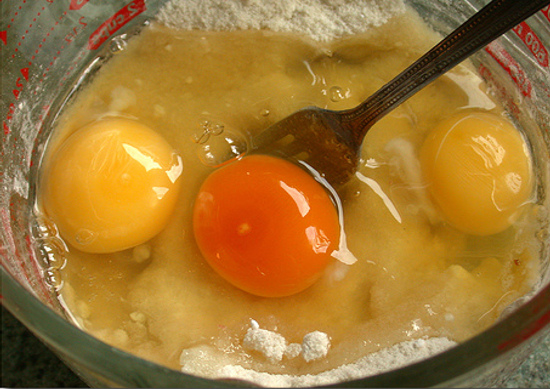
Only one of these eggs came from a pastured hen. Care to guess?
THE YOLK is bigger, taking up a larger portion of the egg. It is also a darker, more orange color when compared to the pale yellow yolks of battery hens. (Note: The color may vary based on the season and how many bugs or green grasses the hen eats, but it will always be noticeably different than the pale yellow of supermarket eggs.)
THE THICK EGG WHITE is bigger and noticeably thicker.
THE THIN, RUNNY EGG WHITE is smaller.
And, now, I present the ever growing list of Healthy Foods: What to Buy:
- Healthy Milk: What To Buy
- Healthy Cheese: What To Buy
- Healthy Meats: What To Buy
- Healthy Seafood: What To Buy
- Where to Buy Butter from Grass-fed Cows
(picture bottom: jocelynmccauliflower)
 |










We recently watched a TV program here in Australia, it’s a “all about food” program. Reading this I guess the “no added health benefits” of free-range vrs cage eggs conclusion that they came to could be because of the lack of truth in labelling.
However, my Dad used to be a “what’s cheapest” eggs guy, and then we watched a different TV program. It’s about a British Chef, who takes a group of people who love eating “instant” supermarket chicken. He shows them how he raises the chickens, and he shows them Real food alternatives to their instant ones, along with a taste test. Then they visit a factory farm.
In summary, the ethical reasons for buying free-range eggs mean that even if there is no health difference.
wow- I had no idea there was such a difference, actually I didn’t know there were TWO different kinds of egg whites.
I am so conditioned to like the yellow egg yolks that my first reaction to the orange one was “EW”. lol. This was extremely helpful and a nice reminder.
What I find interesting is your second and third choice- personally I would choose organic, as I’m not interested in additives to my eggs, and the environmental impact is more meaning for me- however i see that your point is nutrition. So really, after pastured I would think it’s about personal choice (which isn’t much).
This makes me want to get my butt over to the market this morning!! 🙂
EcoYogini
the best option is having your own hen though. unfortunately my most recent chicken turned out to be a rooster and then got attached by a raccoon last weekend :/
Carrie
poor chickadoo what a bad death he passed through
we started getting local eggs from a farm here, last year and i couldn’t believe 1. those yolks, amazing and beautiful and 2. how much better they tasted.
we are very lucky that way, because as you said, from packaging, you never know what you are going to get.
our first farm fresh eggs, came from my aunt pat from her hens and my daughter went out and collected them and we ate them 20 minutes later. it was amazing.
treemama
It’s too bad that food growers are picking up on wording such as “free-range” and “organic” to mislead consumers. This is no different with many other food products. I see a lot of people buying eggs like this in stores, but I’m happy to report that at our local co-op and market the eggs which disappear the fastest are those from the local egg growers who allow their chickens to roam and eat and forage naturally, and are untreated with antibiotics or medications. Great article!
Raine Saunders
Alison — I would agree, but my point is simply that even with the “free-range” label you’re not getting enough ethical improvement to justify the additional cost. The cost difference is huge. You could pay $.69/dozen for a battery hen caged egg, or you could pay $3/dozen for so-called “free-range” eggs that offer no nutritional advantage. If the hens aren’t really even free- range and still live in mostly inhumane circumstances indoors, then what exactly are you paying for? A slightly better living situation that’s still quite bad? Some may decide that’s worth the cost, but many would not.
Eco Yogini — Ha ha. I know that feeling! To be honest, I rarely get an egg THAT orange. When I do, I know the chicken who ate it was aggressively going after green grass, as that’s what increases the beta carotene content enough to make it bright orange.
Carrie — I agree! Unfortunately, our HOA rules make owning chickens illegal for me. I have thought about getting DUCKS though. I hear Khaki Campbells lay an average of one egg a day for almost the entire year.
Treemama — Yes, I’ve found that if someone is a real egg lover, they invariably LOVE farm eggs so much more. If someone simply likes eggs as ingredients in things, they may appreciate the better quality eggs, but it doesn’t send them into rapturous fits of delight.
Raine — Thank you. I decided to launch a new What To Buy series of posts because I get asked these questions all the time. Like I did today, I’ll be answering strictly from a nutritional point of view, although ethics and sustainability will come into play, too.
As a Poultry Egg Farmer I’m telling you right now 80% this article is just factually wrong. If you want some real answers don’t hesitate to ask me.
Pastured eggs really do taste different. I laughed when I heard people say that before I tried one. I mean, an egg tastes like…an egg, right? But grocery store eggs have hardly any flavor any more (like most grocery store food, I’m sorry to say) and pastured eggs taste, well, eggy!
Another ploy of grocery store eggs is nutritionism: adding a “higher in Omega 3!” label to factory farmed eggs means that the chickens are fed rancid oils to boost the values in their eggs. Those rancid oils are not good for the chickens, and therefore, I must assume, not good for us, either. The eggs with the highest Omega 3 content are from pastured chickens, by far.
Local Nourishment
I just want to point out that chickens do not “pasture” in their natural state. They were originally jungle birds that cruised around in small groups.
I’ve tried to provide chicken heaven for the chickens I keep for eggs & meat, I have about 35, & about the same number of turkeys. They have a 1/2 acre house paddock that’s intensively planted, & a 4 1/2 acre paddock to patrol.
They have a great life until we kill & eat them. I understand this couldn’t be done on a grand scale commercially, but open forest would give them more diversity. The number of chickens one sees in the ads would soon denude a small paddock, & there’d be few bugs for them.
Our six hens are finally laying! My kids think it is so neat to have hens pecking all over our property. We of course love the fresh, healthier eggs, too. There truly is no comparison.
What about Fertilized eggs? In one of Sally Fallon’s books she says that one of the grocery store eggs she recommends (if you can’t get pastured) are Trader Joe’s fertile eggs. What is the benefit to being fertile?
Thanks!
It is actually the grass the hens eat that gives the yolks that orange color, an indication the Vitamin A content is high, just like cows eating grass produce yellow butter. Chickens eat a surprising amount of grass, clover, and “weeds”. You should see what they’ve done to my lawn!! Bugs are good too and contribute to the nutritional content of the eggs.
Another labeling misnomer is “vegetarian fed”. Chickens are not vegetarians. When you purchase eggs labeled as such, they are fed genetically modified amino acids to make up for the lack of animal protein in their diets. If you raise your chickens in an immovable pen and feed Purina’s Layena (one of the “vegetarian” feeds available to home flock owners), for example, you aren’t producing eggs much better than the cheap store eggs.
Fertile eggs are not any higher in nutrition than non-fertile eggs. It just means there’s a rooster around. Of course, you would never have fertile eggs in a battery hen house or even one of the commercial “free range” set ups. So traditionally, “fertile” indicated the chickens came from small farm or home flocks. It really is a meaningless word in terms of nutrition.
Thanks for the post and the lovely pictures!
Wow.. This is really amazing!! I never knew that there could be so many differences in the eggs!! I always preferred the cheapest ones I could buy.. Now I will have think twice before I buy!!
Simply Ridiculous
Sorry you can NOT post EGGS FOR SALE on Craigs list, they will NOT let you
Atlanta — Ah, but you can post EGGS WANTED and let people who have extra eggs contact you. (I’ve done that multiple times in the past.) Plus, as a seller, you can often find other ways to word it. I regularly see people with eggs for sale on Craigslist, and that is in fact how I found the rancher from whom I purchase my eggs.
Timely post for me. Just found local eggs on Friday and I’ve been talking about them non-stop. They are soooo good. My son is asking for them for bfast and dinner and is amazed at the different colors and sizes. He wants to personally pick his eggs out before I cook them. 🙂 We’re hooked now and will never go back to store bought if we can help it! Thanks for the info!
~Lisa
lunzy
I live in a fairly rural area. i buy my beef straight from the farmer, share a whole beef with a neighbor. I also buy eggs from a local farmer. They are $2.50 per dozen but they are totally worth it 🙂
Amanda
Great post! I was wondering about all of this and you really cleared it up. There is a farmer selling eggs at my local farmers market so I’ll go have a chat with him about it.
AJ
That’s such great info. We used to get pastured eggs all the time back in India-that was before the whole thing got commercialized and the big industrial companies got interested in the business.Now,the local farms have been bought by them and the consumers get commercial eggs. I used to always wonder why my brother here in the U.S used to complain that chicken here “doesn’t taste like chicken at all”. That’s slowly becoming the case back in India too!!
The orange colour of the yolk depends on the carotene content in the feed,and I’ve not seen any yolks of that colour in a very longtime!!
Sweta
I am printing out this information for my family members. Thanks everyone for your comments. Very helpful…
Thanks for the Craigslist tip! I just looked and found three local sellers – I’d already reached the point of not wanting to buy any more supermarket eggs. Some day I’m going to raise my own hens!
Very informative, thank you, especially about the nutrients. I agree free-range is no guarantee the bird gets out to feel sun on her wings or grub for worms.
Organic standards in the UK vary, with the Soil Association – the biggest organic certifier – coming out top for bird welfare because of its flock sizes. Size matters. They are small enough for the birds to get access to the pop-holes, spending more time outdoors on fresh pasture.
Here are links to two English organic farms known for their high standards, one in berkshire, the other in Devon: http://www.sheepdrove.com/112.htm
http://www.rafael-eu.com/Providence-Farm-Holsworthy-Devon.html
I buy Soil Association eggs or ones from small family farms where the birds lead natural lives. Certification is useful but not so necessary if you know where your eggs were laid. Know your farmer – know your food!
Elisabeth
I was so happy with the color of the yolk this batch of “country eggs” were! That orange in your picture, that’s what they look like. My sons were amazed and I told them it was because the hens were happy at their place and eating bugs.
Once we even got a double yolker. That was pretty fun.
Motherhen68
Motherhen68 — That’s great! The eggs I buy come from chickens that aren’t out in pasture, but in a sort of extended yard. So, their feed is supplemented. In a given dozen anywhere from 1 to 4 eggs will be more orange than the others. I figured those come from the aggressive hens who out-peck the others for grass and bugs. I’d LOVE to get a dozen bright orange eggs every time. So tasty!!
I usually eat 2-3 eggs daily, and so does my husband. With that rate of consumption we’ve become very particular about eggs. Supermarket eggs are just boring, once you’ve become accustomed to “backyard” eggs that are truly free to eat as natured intended – outdoors where they can choose among plants, bugs, seeds, and grain supplements (if needed). I only resort to supermarket eggs in desperation, and even then, I go for organic so-called free-range with flax seed added to the chicken feed.
Great post!!
There are several online (US) sources for good “real eggs”
and surprisingly affordable….. you do have to buy 5 or 6 dozen at a time.
Marc
Marc Feel Good Eating
Awesome article. thank you. I linked you on my blog!
.-= Rachel´s last blog post …Ft Worth Eggs =-.
My problem with food is that I am trying to avoid harmful food colourings. I recently heard that some poultry feed contains substances that can be harmful, to make the yolk look yellow. The worst seems to be canthaxanthin, which can cause deposits on the retina. So how do I know if hens eggs are yellow because they have been fed grass, or because of this? Are duck eggs any safer? Comments welcome, I live in South Yorkshire, so some farms and markets around.
Great post! All to often, the only criteria for buying eggs is price. On Long Island where I live, small delis post signs “2 eggs on a roll with coffee $1.99”. I do not want to imagine what the conditions are for the poor chickens (they are scrawny, unhappy and live in poorly ventilated factories jammed tight). I do not want to imagine what the working conditions are for the poor farm hands (they are poorly paid and must breath toxic chicken waste that fill their lungs). I do not want to imagine what the farmers must feel (their honorable vocation has been transformed into a disgraceful expendable pawn).
.-= Chef Vanda´s last blog post …Seafood Tapas with friends =-.
Fantastic concise coverage on egg types! I’m getting the hang of store bought egg terminology but they certainly don’t make it easy to know what you are buying. Especially with all the conflicting labels “vegetarian fed” what a crock – that so means it is mostly soy. 🙂
Thanks for the Craigslist tip I never would have thought to look there for eggs – just did and there are a few in our area that I’ll have to look into. They don’t all list whether the chickens are pasture fed only or supplemented with feed but it sure gives me a starting point to finding better eggs that don’t cost $4+ a dozen. (most I found were $2 or less!)
A question though, what determines the color of the egg shell – I don’t think I’ve seen green eggs (other than courtesy of Dr. Seuss)
The color of the egg shell is supposed to be the same as the color of the hen’s ear. I’ve never looked at my hens ears, but I do have a black hen with green feet who lays green eggs, while her sister, who has the usual yellowy brown feet, lays brown eggs . . .
Free range and local is the way to go! Even organic eggs at the store can be old and shipped over long distances…
Lovely blog post about the realities and the romance of fresh organic free range eggs. At the our BBC Homestead we feed our hens good feed, plenty of greens, and free range them. We would love you to sto by our blog at http://BoiseBackyardChickens.blogspot.com to visit our urban farming and chicken keeping adventures.
Thanks,
Sara
Founder Boise Backyard Chickens
I have tried and I mean tried! to get pastured eggs from the local farms ..NA na na,,they let them run outside in the spring till fall and then give them soy and corn meal to get them in doors,or in the winter,thats what they eat and they think it,s good and normal..G,M,O,,s is not normal,and the foolish diets for hens is..a joke..I am looking for ALL Pastured eggs<<tHERE IS ONE ONLINE AND THE COCONUT FOODS AND KELP FEEDING FOR THE WINTER IS AMAZING AND SO IS THE PRICE!!! THANKS FOR SHARING..
Amazing difference in the yolks! I’ve had good and bad experiences with purchasing eggs from farmers. I once got some at a farmers market, and they were, BY FAR, the worst tasting eggs I had ever eaten. I have actually found a fertile egg supplier that’s stocked at our local grocery store that looks and tastes even better than our farmer’s $6.00 per dozen (!!!) eggs. I still buy from our farmer because I know for certain that the chickens are grazing 24/7 but I can only afford to buy one dozen per week from them, so I supplement with the fertile eggs when I need more in a given week. They supplement with local grain but I assume it’s not organic grain. My mom is starting to keep chickens again and I convinced her to buy the organic feed…twice the price but hopefully that means twice the nutrition!
Wait, I thought saturated fat was good? Why would we want eggs that have 1/4 less of it?
I already knew all of this. The best Eggs I have ever eaten and I know this article isn’t about meat but both have been the best when we by them from my Aunt and Uncles Farm! 🙂 Always the dark colored brown eggs and they taste so much better! The meat was Awesome as well!
The color of the yolk varies widely though even if you buy farmer’s eggs. Our local co-op buys eggs from local farms. Plenty of them have yellow yolks. My MIL raises her own hens, they are allowed to roam her property and eat grass, and their yolks are a golden yellow. I have never seen one yet, in the last 5 years, that was orange. Maybe it is just the grasses in our area are missing a nutrient with our shorter summers. Just a guess.
The ratio of yolk to egg white is accurate though and is probably the best indication of a “good” egg.
I just say that because I don’t want people to think lighter egg yolks are bad eggs. There are lots of variables that go into color. What you will see consistently is a variable shell size, and variable shell color when you buy from a small egg producer. It is only in large egg productions where they have enough eggs to separate medium sized eggs from large eggs, or white eggs from brown eggs, for example.
Also, some states are better than others at defining locally how an item can be labeled (and supersede federal law). Vermont has lots of labeling laws that do just that. I would recommend checking out what your state requires. Free-range may mean something different in your state than what it means to the FDA.
HTH. 🙂
Good article! Real food is God made not MANufactured!
Want to show this to my sons and grandchildren.
Thanks for this post and tips for where to find real eggs! I will be doing that today.
I follow you on Facebook and have read some of your posts. I’m wondering how to eat “right” on a serious budget/lack of funds. I’m a big label reader and have been for several years now. I’ve read a lot about organic food, conventional food, etc. I’ve watched Food, Inc. I’ve been reading a couple of Michael Pollan’s books. Some I am aware of the alternatives.
My husband is a salesman and his income has gone down significantly. I have had part-time jobs off and on to help out. My mom lives with us and receives food stamps. If she didn’t give us that money for groceries, we’d be hurting even more.
I’d much rather eat clean and my family loves fruit and vegetables, but it is not cheap to buy mostly produce, etc.
I’m not sure if you’ve posted about this, so I apologize if you have. If you have broached this subject, please let me know where I can find your post. Thanks so much! Love your blog!
Blessings,
Melanie
So what’s the best way to buy egg whites so we don’t have to throw away the yolks? Are any packaged egg white products okay?
I always buy “vegetarian fed” eggs, if I have to get them at the grocery store. I was dismayed to find that most chickens are fed feed that is comprised of “cow by-products”, which is not even NATURAL (by any stretch of the imagination).
Look for eggs that are fed a vegetarian diet, i.e. what they should eat anyway…because chickens don’t eat cows.
🙂
Sarah
But chickens *do* eat bugs and larvae, so a vegetarian feed is just as unnatural for them…
I had read that the eggs marked omega-3 are from chickens which were force-fed flax which is not part of their natural diet either. Do you know anything about that?
I can’t find pastured eggs anywhere where I live for the life of me. When I ask a grocery store for it. They usually ask me “what brand is it?”. I say I don’t know because I never seen them in grocery stores. I only know the type. I also describe that they the yolk is orange and the hens aren’t in barns they are out in the open. They also eat bugs and not a lot of grains which is their natural diet. For now, I have to settle for organic eggs which is the next best thing.
You are looking in the wrong place. 99% of grocery stores won’t carry pastured eggs. You need to buy them direct from the farmer. I recommend checking out http://www.eatwild.com to find local egg suppliers near you.
totally 1000% agree, when I sould buy regular organic eggs be it from Costco or Wholefoods…first of all I would get a stomach ache.After I found out more and learned more about this business I stopped eating eggs. I do not want soy! Until I met some farmers and ranchers local to my area, and began to order the foods they offered. One farmer actually raises worms for the chickens to eat, plus they eat other insects, forage thru cow dung, and some peas.They are always outside and happy .So I am grateful for these farmers…Faithful Farms thank you!!!!!
I have yet to find solely pastured chickens. In Wisconsin I’m told they would freeze to death in the winter and are thus brought inside with grain feed. Are there folks that know of pastured chickens year round up north? Is that even possible?
How about labels like humane certified humane, and kosher? Also what’s the political difference between vegetarian diet, grain fed, and whole grain fed? I assume whole grain fed means no corn. partially pastured eggs are fine for me btw.
I’m thankful to get my eggs from a local farmer. They are pastured, organic and soy free!
I buy them from a farmer I’ve known for 5 years.
Thankful to have our own chickens!
Fortunately I work on an organic, pastured poultry farm and get eggs whenever I want ’em. They’re unbeatable and everything from the tall, orange yolk, and well-defined whites are traits I have never found in grocery store eggs or even “farm fresh” eggs from birds without free access to grasses and pasture.
From our own coop 🙂 We free range our chickens.
Yes. They’re $8.00 a dozen and worth every penny.
Our local farmers sell them for between 2.50 to 4.00 a dozen. I love seeing the face if the person who provides our food 🙂
OMG – the right pasture raised eggs with the beautiful TASTY orange yolks are amazing!
I found a great brand lately for pasture raised eggs. They are called Handsome Brook Farm.
Thanks!
Find a farmer.
So what is the health benefit of a yellow or more golden yolk?
Are Brown eggs healthy? Opposed to white?
What is that white growth like attached to the egg yoke?
I have heard that green eggs are more healthy to eat. We have some chickens that lay brown eggs. We are wanting to get some more. Several years ago we had some really pretty ones that were black, green, yellow and red. They laid green eggs and we want some more of them but I can’t remember the name. Do you know?
Appreciate this article. I wonder if you would consider our eggs “real” even though they are available in grocers? Our hens live outside, with mobile houses for shelter. We offer a standard organic and a soy-free organic. (Bethesda Farm in Northeast Florida). Thanks for your feedback.
You still haven’t told us which supermarket brands are the healthiest. For those of us who live in cities, these are the only eggs we can get.
Hi Christine. I linked to the Cornucopia Institute scorecard, and I told you how I prioritize my supermarket egg purchases (preferring brands whose labels say “pasture-raised,” etc). Hope that helps!
This is an amazing piece on eggs. Takes away all the confusion! Thank goodness for people like you ☺️
Hello. What are you thoughts on a brand (hypothetically) like Egglands Best Organic eggs? I like them over CHEAP eggs. The economy Sucks, but if I bake, I try to use Quality product.. I look forward to your reply..
OK you live in Texas and accept for some nominal cold and snow IN SOME AREAS, your chickens can live their entire lives outdoors. I like the models from colder climes with night time enclosures and the chickens are ‘let loose’ during thed ay. I have a video of one such giant operation that is hilarious. the guy opens all the doors with stairs and the chickens fly out and down a hill to where all the good stuff is – grass, grains, bugs and some organic feed for the faint of heart. so they are protected. you have a picture of Joe Salatin in the previous article with no explanation of his methods. I think readers would love to know what that picture is all about. his method is similar to gardening. his pastures have mobile fences for both cows and chickens. he moves the cows to another area when they have pretty much demolished the pasture then moves the hens in for the bugs and small grasses. then the pasture is left to reestablish itself as a beautiful meadow land for the next herd of cows to feed on – no artificial feed. Wonderful.
I enjoyed reading your recommends this morning. Thank you.
THANK YOU for the Craigslist idea!!! I just found Pasture Raised Eggs 15 miles from me for $3 Dozen!!!