
My children and husband LOVE fruit juice. Sadly, there’s not much nourishment in most juices (even the 100% juice kind) besides a whole bunch of highly concentrated fructose and a few vitamins.
In an effort to provide them nourishing beverages that satisfy their cravings, we’ve relied heavily on kombucha (which you can brew yourself for as little as $.50/gallon) and raw milk. But sometimes we break out of that rut, and when we do, we aim for other frugal, naturally fermented, probiotic beverages.
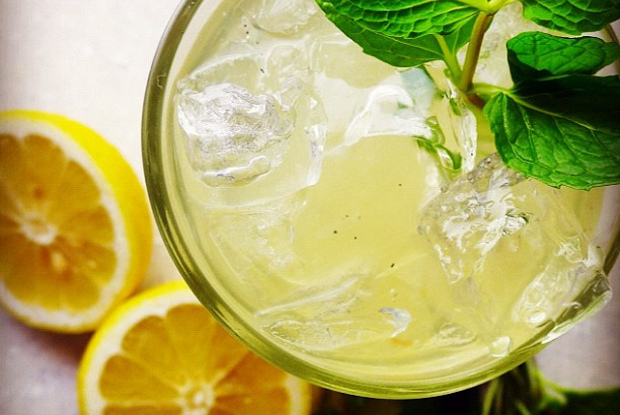
Beverages like this fresh, natural, and healthy lemonade.
Fresh Healthy Lemonade — A Probiotic & Lacto-fermented Treat
This recipe makes one gallon.
The Players
- juice of 12 lemons
- 1/2 cup to 1 cup of sucanat* (where to find sucanat and other natural sweeteners)
- 1 cup of whey (the liquid kind you drain off yogurt!)
- 1 gallon of water
The How-To
Put all ingredients together in a one gallon glass container and stir well. Cover tightly with a lid and let sit on your counter at room temperature for two days. It is now ready to drink or refrigerate.
Some Notes


*Sucanat is a brand of organic, naturally-evaporated sugar available here in the U.S. Adjust sugar content according to your tastes. Remember that most of the sugar will be eaten up and used as fuel for the lacto-bacillus culture, so your end result will be significantly more tart than what you originally stir together.
Be sure to use living whey that was drained off yogurt (as shown here) or separated from raw milk. The goal here is to get a living culture of probiotic bacteria, so you don’t want to use the whey left over after the cheese making process (which has usually been heated/cooked). And, as always, filtered water is best.
Enjoy!
(photo by chotda)
 |




Reading @foodrenegade, rather unique #lemonade recipe, healthier than most. http://bit.ly/9Jx9v
This comment was originally posted on Twitter
Food Renegade » Blog Archive » Fresh, Natural, Healthy Lemonade Recipe http://is.gd/35e4Z
This comment was originally posted on Twitter
Food Renegade » Blog Archive » Fresh, Natural, Healthy Lemonade Recipe http://bit.ly/fY39K
This comment was originally posted on Twitter
Food Renegade » Blog Archive » Fresh, Natural, Healthy Lemonade Recipe: My children and husband LOVE fruit juice.. http://tinyurl.com/moekrs
This comment was originally posted on Twitter
Interesting! We rely on water kefir or ginger beer when we want something aside from water, I’d never thought to ferment beverages without some sort of SCOBY. I bet this is incredibly refreshing.
.-= Jenny @ Nourished Kitchen´s last blog ..Eat Your Beef & Butter: CLA, Disease and Diet =-.
do you “culture”it,ie.let it sit for some time, or drink immediately?
.-= emily´s last blog ..The Real Food of Summer: veggies and butter! =-.
Emily — Ack. I did a security update to my database earlier today and have had problems with my posts being cut short by it. I’m going in now and restoring older versions of posts, etc. But, in the meantime, I edited this one to answer your question (which it originally did before I screwed up the database).
Sorry you are having trouble with the site – I love it! Anyway, wanted to let you know that your “resources” page is down – i.e. there is nothing on it.
Ashley
What is meant by ‘whey’ in this recipie? Is it whey protein powder? Or some kind of liquid? I’m a bit unclear on that being I am new to this sort of beverage
I have made the Orangina recipe out of the Nourishing Traditions recipe book and it requires two days at room temperature and then in the fridge. It is just oranges, salt, whey and water.
Kristen, that lemonade sounds really good! Now I just need to find some more good kefir grains and start brewing again. I somehow managed to mess mine up. They started brewing really sour watery kefir with small ricotta-like curds, no matter how long I cultured. We’re missing the kefir! Also, I’ve only been reading Food Renegade for a couple of weeks, but I love it, especially Fight Back Fridays!!
Rachel, I’ve seen that recipe. It looks interesting. How did you and your family like it?
Hi – yes, I need more info on whey too. I have never heard of sucanat. My latest discovery is a UK product called Sweet Freedom, made from 100% fruit and low-GI.
Kristen – I am also trying to get an update on the proposed US bills (HR875 and S425) which will insist that all food growers must pre-register – this will have huge impacts on farmers’ markets, CSAs etc. And the inspecting will be outsourced, possibly to the very agribusinesses which are lobbying for the bill.
bit.ly/JgVKp
Thanks
.-= Elisabeth´s last blog ..Hemp porridge knowledge =-.
Elisabeth & BJ — As I commented above, it turns out that some security upgrades I did cut off the last half of the post. It’s now been fully restored and should answer your questions. 🙂
Hi, Kristen, do you by chance know the nutritional info for this recipe, for example the calories or sugar count or fiber by chance? I LOVE this recipe and drank the whole gallon (over the period of a week) by myself (DH not into lemonade). Could you make this with ginger? If so, when might you put the ginger in? Any ideas?
thanks!
.-= Jessica Waters´s last blog post …foodiegrrl: @LunaandLarrys a little bit of chocolate hazelnut never hurt anybody! =-.
I love lemonade! Thank you for sharing this healthier and more nutritional version. I enjoy Kombucha immensely, thanks to your tutorial, and I will definitely give this a go. Sounds so easy, too. My dad (who was born in Italy) used to do the lemon water thing long before I knew of its all around health benefits. He used so many natural remedies, passed down from generations. I wish I had paid closer attention.
Thanks Kristen, you are one of the best!
“The goal here is to get a living culture of probiotic bacteria, so you don’t want to use the whey left over after the cheese making process (which has usually been heated/cooked).”
Hi Kristen
I’m confused… not sure what you mean from the above statement. I thought draining the whey from yoghurt IS the cheese making process and therefore you wouldn’t HAVE whey until AFTER the process.
PS. I have never made cheese, whey or any lacto-fermented products. I am keen to try but a lilttle nervous about the whole thing, having never even seen these foods before… except cheese of course.
Deb
Deb — LOL. Sorry to be confusing. The recipe for “cheese” linked to in the article is basically a sort of cheater’s soft cheese. It’s basically just drained yogurt. To make hard cheeses (like cheddar, for example) requires a much more involved process and quite often involves heating the raw milk to temperatures that can kill bacteria. The whey left after that process has thus been “cooked” — for lack of a better word. You *can* make many of these cheeses and manage to keep the whey raw, but most often that’s not the case. So, the point is to have and use raw, living whey. If your cheesemaking process leaves the whey raw, then use it. If not, then feed it to your animals.
Sorry, you’re mistaken about this. Cultured dairy products like cheese and yoghurt are either mesophilic (low temperature) or thermophilic (high temperature) processes. A few cheeses (ricotta, paneer, queso blanco, for example) heat the milk to boiling. The others are not heated to more than 115 deg. F. That’s considered to be a thermophilic product, and yoghurt falls in that category. Most recipes for yoghurt instruct you to heat the milk to 180 deg. F. and then let it cool to 115 before culturing it. Cheddar is actually a mesophilic cheese, and the milk is heated only to about 85 deg. F. So it’s actually made at a lower temperature than yoghurt and its whey would be more suitable for other uses. Of course, if you make either yoghurt or a mesophilic cheese with pasteurized milk, it has already been heated to a high temperature before you make anything else with it.
I usually get my whey from making raw organic grass fed milk kefir. I do sometimes make raw yogurt or raw mozzarella by not allowing the temp. to go over 100.5 degrees. That is the temperature of a cow. Anything over that is like the cow having a fever and varying degrees of pasteurization.
So, the websites that claim that it’s impossible to make mozzarella raw is not true, I do it.
Could you share your best Mozzarella Raw recipe? I have wanted to do this for my children but got so confused in the learning process that I gave up. Thanks!
Sounds sooo good, thanks! (I wasn’t confused:)
But, does dead whey have any benefit? Above you said to just feed it to the animals.
.-= Kyle´s last blog ..I’ve switchd to Blogger =-.
Just a quick question…during the fermenting process does it produce alcohol? I tried fermenting fruit before to make preserves, but it tasted like the fruit had produced alcohol. we don’t drink at all, and certainly don’t want the kids to drink hard lemonade! 🙂
Jutta — This is mostly non-alcoholic fermentation. I’d bet there’s less than half a percent of alcohol in the final product. Instead what you’re getting is LOTS of lacto-bacillus culture — the really great probiotic bacteria found in yogurt, fresh cheese, and even sauerkraut.
Kristen, I made this today with my daughter. She is a petite 8 year old and had to work really hard to help me squeeze all 12 lemons but she loved it! Can’t wait to drink it. She is already envisioning how she’ll smash the competition next time she and her friends do a lemonade stand!
Our lemonade is ready to drink. We added Stevia and it is really refreshing.
Would it work with honey instead of Sucanat? This sounds good but I am on GAPS.
.-= Bethany´s last blog ..GAPS "Pumpkin" muffins =-.
Bethany — Interesting question. Honey is anti-microbial, so I’m not sure how well it would do IN the ferment. But, it could certainly be added AFTER the fermentation time. Or, you could try using Stevia to sweeten like Lauren in the comment above you.
Thanks for being part of the carnival yesterday!
By the way, yours and a few other entries didn’t get saved on to Pennywise Platter yesterday. So sorry about that! My internet wasn’t working right and didn’t “publish it”. But it’s on now! Someone (I don’t know who) had also formatted their comment wrong and it was wigging out the formatting on the post, but it’s all cleared up now. 🙂
.-= Kimi @ The Nourishing Gourmet´s last blog post …Spiced Apple Muffins (Gluten, Grain, and Dairy Free) =-.
Okay, so… clarifying here. 🙂
All my cheeses (soft and hard) are heated to no more than 86 degrees. They are cultured with mesophilic (middle temperature) cultures. I consider them raw. According to all the comments here, I am assuming I can use the whey for my soaking? If so, that is awesome! I thought there was something about “cheese” whey that made it not useful for soaking, no matter the temp of culturing the cheese.
.-= Wardeh @ GNOWFGLINS´s last blog post …Chocolate Milk: Shake It, Kids! =-.
Sounds perfectly raw to me. 🙂
When I make yogurt I heat the raw milk to 180 degreesfirst and then let it sit overnight at 110 degrees. Doesn’t that first heating render it “cooked”, thereby making the whey that comes off the yogurt NOT raw? Help?! Also, yes, I was unclear about if it sits out to ferment before drinking, or is that what the whey is for? Thanks! Kelly
Hi Kelly,
That first heating certainly kills off the bacteria and enzymes, but then you re-introduce a living culture of bacteria to the milk and allow it to ferment at 110F to turn the milk into yogurt. So, now your whey is repopulated with healthy, living bacteria!
And yes, you should let it sit out to ferment BEFORE drinking. You can drink it without the fermentation, but it won’t be fizzy or as probiotic.
Hope that helps!
I recently used a batch of whey from some queso blanco cheese I made to try my hand at culturing carrots. On the second day of my carrots being on the counter in a solution of 4TBS whey to 1TBS salt and the remainder of the quart jar filled with distilled water, I noticed the lid was bulging. When I unscrewed it to release some pressure, there was some fizz. On the morning of the third day, there was so much fizz that the liquid overflowed when I went to release more pressure. The reason I mention this is becuase this particular cheese required my raw goat’s milk to be heated to 185 degrees at which point I added the vinegar to separate the curds from the whey. Even though it was heated to this degree, there was still enough bacteria remaining to ferment, and rather quickly I might add! All this to say that I wouldn’t necessarily consider whey that was heated to 180 degrees “dead”…mine was quite alive even after 185. I also had some fresh diced ginger in the jar whose sugar probably aided the fermentation, but I’m guessing that if my whey was dead to begin with, I would have just wound up with moldy carrots a week or so later rather than yummy cultured ones on day 3.
Hi Kristen! I made this and loved it! Linking to your recipe as the basis and inspiration for my Delightful Citrus Sparkling Tonic. See link here: http://amoderatelife.blogspot.com/2010/05/two-for-tuesday-whey-soda-and-sourdough.html
As always love everything you do! 🙂 alex
.-= Alex´s last blog post …Two for Tuesday! Whey Soda and Sourdough Croutons! =-.
My nursling has a dairy allergy, so I can’t have whey. Any suggestions for a substitute? I really want to try this!
Can I use a bit of lime juice in with the lemons? And is Rapidura sugar ok?
I don’t see why not. Both the lime and the rapadura sounds lovely!
I love this drink. So my question is that in the fermentation the sugar is used up. does that mean that it no longer has the sugar affect on our system. My daughter is on a very low carb diet to help her with her seizures. There is no room for fruit juice or sugar. Would the sugar in this drink be “used up” before she drank it?
Rose — I don’t think ALL the sugar is used up, just most of it. If it was all used up, there wouldn’t be any sweet taste to this drink at all.
Can Xylitol and live yogurt be used for the Lemonade drink without compromising
the probiotics?
I am intolerant to sugar from sugar cane and sugar beets. Could I use grade B maple syrup in place of the sugar?
You could certainly try. You need sugar to feed the bacteria and so you can get a good ferment going. Maple syrup has sugar, to be sure, so it will probably get the job done. I’m just worried about how it will taste.
I love this recipe. We strain our yogurt with coffee filters, lining a wire mesh strainer, this yields really clear whey (instead of cloudy with bits of yogurt). I don’t know if that helps anyone. We also tried this with our almond yogurt (dairy-free) and with kefir whey. We love it and it’s so much better than giving the kids juice. Thanks!
Would this work with frozen whey? I end up with SO much whey that I eventually freeze it! This would be a great, healthy way to be able to use some of it up!
thanks you…was looking for a lemon version
I just printed this and i’m getting ready to try it!
Foodgawker is showing your blog about the orange juice on Facebook! 🙂
How cold one adjust this for a dairy-free diet? I love the idea of it!
You can use a non-dairy starter culture instead of the whey. I’d recommend you take a look at the vegetable starter cultures listed here.
I’m curious. If after it ferments, the kids balk at it because it’s too tart, would it be OK to add Stevia to taste?
…without hurting the nutritional qualities…
I have made this twice now and it is super yummy. I made it for a summer party and get rave reviews. Going to make it for the family cook out in a couple of weeks
Where do you find a glass gallon container with a tight fitting lid? The biggest I have is half gallon…just 1/2 the recipe?
Try calling bars, retaurants and delicatessens. They often get their olives, etc in gallon glass jars and would be happy to let you have them for free.
@Jane — I bought some at Target ages ago for $5 each. Before that, I got a set at Big Lots. Keep your eyes peeled.
@Jane — I bought some at Target ages ago for $5 each. Before that, I got a set at Big Lots. Keep your eyes peeled.
@Sue — I don’t see why not.
I got mine at Big Lots.
I think cucumber lime with raw honey is great on a hot day !
Yum! I have to find some organic lemons.
Thanks, I’ll go hunt some down 😉
Will a ceramic container work or must it be glass?
what would a casein-free way be to get it fermenting? can’t do whey!
Jessica — Anything but plastic or metal will work well.
Julia — You can try using a vegetable starter culture.
Wow, what a great recipe! And I can use the whey from the yogurt I strain to get thick, creamy Greek style yogurt? I am definitely trying this!!!
Dairy allergies here. Is there anything besides whey that will work? Dying to get my kids to do anything fermented that will help their destroyed guts.
Thanks!
Hi Susie, please see my comment made in reply to Laura above for a link to a non-dairy starter culture! Thanks. 🙂
Thanks for the recipe. There’s one point: Metal is the killer of vitamin C. I do not agree with you when you are suggesting stainless steel things for that.
This may be a silly question, but 1 gallon of water + all other ingredients = does not fit in a gallon sized jar. At least not mine. What do I do?
Can you drink this while nursing?
Maybe I missed it, but can one use protein powdered whey? Can whey be extracted in the same way from Kefir? How much yogurt do you need to extract 1 cup of whey? Thanks for the help – I bought a dozen lemons yesterday and my husband has started using them thinking I’ll leave them till they rot!! Help please! 🙂
You can not use powdered whey because it is dead. The whole point of adding the whey is to introduce a lacto-bacillus culture to the mix so the lemonade ferments.
Yes, whey can be extracted from kefir. The amount of yogurt you would need will vary based on the thickness of the yogurt.
I took the whey from yogurt as you advised (I had elsewhere to find it) but to be honest I’m not sure wht the whey did for my lemonade..
The you advised was really intense and took alot of sparkling from the lemon taste.
Not sure I liked it… It sounded great though.
The purpose of the whey is to introduce a lacto-bacillus culture to the ferment. This ensures that the lemonade ferments, the bacteria essentially eating the sugar and replacing it with beneficial acids, extra B vitamins, and reproducing to create lots more probiotic bacteria. It also has the pleasant effect of making the beverage somewhat fizzy!
I just made a batch this morning but…. I didn’t even think to strain out the pulp and a few seeds also got in. I am okay with that, I just hope the seeds don’t poison us! I let everyone know how it goes!
My lemonade wasn’t fizzy at all. Is this common?
I have lemonade on my counter and can’t wait to try it. I need to calculate the carbohydrates for my two Type 1 Diabetic girls. Do you know if the whey and sugar reacting together change the carbs?
Can you use low-fat plain yogurt to make the whey? Also, I don’t like the taste of kombochu, at least the ones I tried tasted and smelled like vinegar. Does this recipe taste vinegar like? Thanks
i am sharing this with all my Aussie friends and i bet they are going to love it as much as i do.
xxx
It has been 2 days and so far my lemonade isn’t getting fizzy. I can’t figure what I did wrong. My whey was made from plain yogurt from whole foods. And it’s not very old maybe a few weeks. Does it have to be whey made from raw milk yogurt, which can not be found at the grocery store?
I made a “ginger bug” last week with ginger, sugar, and water and used that to ferment an orange-passion fruit soda…nice and fizzy, not too sweet. I’ve been looking for more ways to use it, and I think it might work great in this recipe. We’ll see what happens.
Hi I started a batch of lemonade yesterday morning with whey I drained from my homemade yogurt.
it’s been sitting for about a day and half as I write this. Last night I noticed a white sediment on the bottom of the pitcher, I assumed it was milk fat settling out. Right now there is fluffy looking cloud rising about an inch and half from the bottom…. is this normal and part of the fermentation? and do I stir in before drinking? or do I pour it out and start again ?Thanks -M
Yes. This is actually strains of dead/dying yeast. You can either consume it or remove it if you find the texture/look off-putting.
Thanks for the recipe. My batch has quite a bit of this on the bottom…how would you remove? Strain the whole thing before drinking?
So, I made this and let it sit out for two days and then noticed whitish stuff on the bottom of the container and what looked like a combo between bubbles and almost a white mold growing on the top of the liquid… is this normal… should that be skimmed off or just stirred in? I hope I hear back soon because my kids are sooooo excited to try the drink:)
The growth at the bottom is actually strains of yeast and/or bacteria dying off. If the stuff at the top is actually fuzzy, then it’s mold and I wouldn’t drink it. Next time disinfect/sanitize all the surfaces that will come in contact with your ferment and see if that helps. It ought to be acidic enough from the lemons that mold shouldn’t grow before the probiotic culture takes over.
If, however, it’s just white fizz and bubbles, then that’s the evidence of your bacterial culture and the fizzy, natural carbonation your ferment produced. So, drink up and enjoy!
I made a batch a few weeks ago and we loved it! My daughter has been asking for more lately. This time, i thought cleverly, i’ll use my fancy blender to juice those lemons and then just strain the pulp out. Save myself the tennis elbow.
Weeeellllll… i was left with a pulpless, but frothy lemon juice- quite opaque. I added the other ingredients as called for in the recipe and now it sits in my basement. When my husband looked down there at the fermenting shelf he said, “you know you have a jug of bone broth down there, right?” Ok, so it doesn’t look like the first batch did. Do you think the addition of some pulverized pulp will hinder the fermentation process??
Love your site! I rely on it daily for ideas and articles!
Thanks,
Amanda
Hi! I know you received an overwhelming amount of comments/questions pertaining to this ONE post alone!… But I have 2 unanswered questions. (I read through the other comments, just in case!) I’m brand new to this technique of DIY fermenting. I’ve over-studied it, in fact, glycolysis is one the tip of my tongue!
Question#1-can you suggest a whey precursor that is cost effective and preferably store bought?… (I know! Sorry! If it works, I’ll try the fermenting kits). In your pumping cream cheese tutorial, you said to use yogurt…will any unflavored organic yogurt do?…
Question#2-should the whey be at RT or in the refrigerator prior to the fermentation process?
Thanks a bunch!! I hope you find the time to respond 🙂 I’d love to get used to this age old practice!
Plain organic yogurt will do fine. You could also use a vegetable starter culture from some live sauerkraut (not usually store bought, as most of those krauts are shelf-stable and pasteurized).
I don’t think the temperature of the whey/starter culture matters much in this. I’ve let it come up to room temperature and I’ve used it straight out of the fridge. I haven’t noticed any difference!
Will the fermentation work if I substitute salt for sugar? I want to avoid the sugar.
I don’t know. It will likely ferment, but it won’t taste like lemonade.
I thought that lemon could be used to kill bacteria. How do the bacteria in the whey survive the lemon juice, do you know?
I am taking a chance asking a question, although so many people already have. I brew kombucha, and that is not covered or cut off from air, as I just put a tea towel over it. Am I assuming correctly that this in ANAEROBIC in nature? The lid needs to cover tightly enough to cut off oxygen to the fermenting beverage? I am so confused when I am doing ferments as to when it needs air and doesn’t. (Is the answer if it contains whey it does not need air?) Also I am using the whey drained off of curdled milk, assuming that’s okay. MANY THANKS for what you do!! Much appreciated, and all of our health benefits!
I’m trying this right now, but I noticed that one gallon of water plus all the other ingredients do not fit in a one-gallon container. About 3 quarts of water fit. Did anyone else have this issue?
Can I use lemon juice from the bottle instead?
I was wondering the same thing. I have tons of organic lemon juice… I am going to try it today!
I’ve made this a few times and my kids love it. This time i’m thinking of adding a bit of beet kvass after fermentation to make it PINK lemonade. my daughter goes nuts for anything pink, much to my dismay.
Hi. I love this lemonade! Made three batches already. So glad to have a probiotic drink made at home that is so much quicker and easier to make than kombucha, which we love. I actually have a question about lacto fermenting vegetables, like cabbage, carrots…made both recently. Rather finished both, and out in fridge. Carrots are great! Actually just read that if they are slimy they are bad. Uh oh…mine are. But we like them. No mold. Look good. Eaten half a jar! Should I be throwing them out? What went wrong? And my Sauerkrout, looks good, smells fine. Just out some on plate first time today. Liquid is below cabbage though. Not sure for how long. It had been leaking out while fermenting. Is it ok? Should I just add more salt water?
i find the gas that is produced in fermentation pushes the cabbage or whatever up above the liquid line, which is also what makes the jars leak. you can open the jar to release gas and close it again, pretty often. or just push the cabbage back down under the water. or just be lazy like me and ignore it :0) it will still be fine to consume. once you start fermenting a lot you will find there’s a lot of flexibility.
Can you do this without whey? I’m on dairy restriction sadly.thanks
usually if you leave out the whey, you need to double the salt. leave it out unless you have the dairy whey. powdered whey from stores doesnt work.
Hi there,
I just made this lemonade and used the juice from 12 lemons, but these particular lemons seemed to be yielding a lot more juice than I’m used to.
I added a full gallon of water and it tastes very overly lemony. Will it get milder as it ferments? Or do I need to add more water?
How much juice did you get from your 12 lemons?
I had about 3 cups.
I tried to make this and followed the directions almost exactly but mine didn’t seem to ferment. The only difference is that I didn’t have a gallon so I mixed it it all together in a plastic bowl and then divided it into quart jars. Should I have kept it in a dark place or should it have been fine on the kitchen counter? Is there still a chance it will fizz up if I let it sit longer or is there a way to revive it? Really don’t want it to go to waste with the price of lemons in Alaska.
I tried letting it sit longer but now it’s begun to get mold on top. What did I do wrong?
Do you know if it would turn out if I used a ginger bug instead of whey?
hi…thanks so much for this interesting fun healthy project. i have a batch just starting this afternoon. i hope i did everything right. i even sterilized the huge jar in the oven as i do my canning. i read through most of the comments, but didn’t see if anyone asked how long this will keep in the fridge…also, can you 1/2 the recipe and still get the same effect? one more…can you use whey that has been saved in the freezer? thanks again
hi…jules again. woops!, i used raw honey for my sugar. i read more about it AFTER i made my batch and found that honey does not work…or it might, but it takes a lot longer. i will have to re-do…bummer. any thoughts you have on the honey situation? i will not toss it yet.
Oh no! I didn’t read ahead and just make this recipe from whey that I got after making cream cheese. I heated the milk to 90 degrees and then the whey drained on my counter for over 8 hours… Any chance it’s drinkable?
If the milk was raw when you started, then heating it to 90F won’t kill off the bacteria or enzymes and your whey is probably still probiotic. Technically, a food is still raw until it reaches 118F.
I can’t wait to make this. Already have my lemons but I stopped making ferments with whey a while back and just let it ferment on my counter a bit longer. That’s how I make my sauerkraut for example. I do not have whey on hand right now, Can I just let it all ferment 5 days-a week on my counter instead?
Hi,
I made this recipe for the first time. I used left over whey from making raw cheese. I believe this whey is still active because it has not been heated and I have stored it in my fridge for only a couple of weeks. Also, I don’t have a juicer of any kind so instead of just juicing the lemons I used the whole inside of the lemon (not the pith or rine)and pulverized it with my vitamix to make the lemon juice and instead of sugar I used equal amounts of raw agave.
The problem is after the two day fermentation period I have noticed a small amount of mold (long thin hair grey hair-like). Is this normal? Is it still okay to drink if I remove it from the top of the jar? Should I just through it away?
Thanks
I really like this! Now it has been in the fridge probably a week or so and it has a white ball of something growing in the middle of it, is that mold? Normal or has it gone bad?
Although not ideal, and I want to use fresh lemons for this, but could you use bottled lemon juice to make it? We had purchased lemon juice for a master cleans but had to stop the cleans early. Now, we have all this lemon juice in my fridge and don’t want to waste it.
Since I will be using live fresh milk kefir whey that I will be using, it will have a live culture. I was also wondering how much lemon juice would be equal to one lemon?
I’m going to start on a lacto-fermented gingerale and also want to do the lemonade.
I’m not sure if anyone is still looking at comments here but I just tried making this lemonade, and I don’t think it worked! It’s my first fermentation project and I’m new to real food (ha) too, so please bear with me!
I followed instructions exactly, and no fizz after two days. I thought I saw what looked like bubbles at the bottom of the jar before opening, but definitely not fizzy. Would you let it sit longer? Is it possible I used the wrong portions of the ingredients, or would that not matter?
And Please bear with me for a VERY stupid question… But my lemonade came out brown, since the sucanat is brown! Is that how everyone else’s came out?
Can you use this recipe with oranges??
thanks,
Victoria
Hi, this looks amazing!! I’m really interested in making this because I love lemonade, but our family is dairy free so I’m wondering if it can be made without the whey?
Thanks 🙂
I made this with added grated sweet potato plus two lemon juice and jest. I make it in one liter of water. I have taken half a liter out and put it in a soda stream bottle then filled the bottle with water and sealed, left on the bench for two days then refrigerated to drink as I wish,
I added the 500 ml water plus 1/4 cup sugar and 500 ml water to have the fermenting bottle bAck to one liter and leave sit for a few days, so I get two sodastream bottles of lemonade a week, I have strained the sweet potato and lemon zest and removed it from the fermenting bottle. So far it keeps fermenting.
My questions are, how long should this keep fermenting if I keep adding the sugar and lemon juice twice a week when I refill the sodastream bottle.
Would it be possible to add mint or would it just turn to slime. Should I try using mint tea instead of water?
Thank you
Debra
I just made probiotic lemonade and love it. Do you know of any resources that talk about the quantities and types of probiotics we would be getting when we drank this?
Thank you.
My baby belly and I have become obsessed with watermelon lemonade recently. Would you add watermelon juice to the fermentation process or just cut the probiotic lemonade with watermelon juice just before serving?
Thanks!
I would love to try this out! We love Lemonade 🙂 is there something I can use instead of whey ? We can’t get raw organic milk here in Denmark.
It sounds like whey from milk kefir would be ok to use here but I don’t know if it has the culture you mention that yogurt has. Will the whey from kefir also eat and use the sugars too or should it be made differently?
Not sure if you know this or not, but you can use whey that’s leftover from making kefir cheese. This is what I plan to do tomorrow 🙂
Where can I find whey, the liquid kind?
It’s so easy and so yummy! I can’t get enough of these!
Sounds delicious…I’m sure it would go fast – but with only 2 people in the house I was wondering how long will it last in fridge once ‘ready’ in 2 days? Thanks!
Hi Kristen, I am a recent subscriber and enjoy what I see so far. Really want to make the fermented lemonade but am wondering if I can use the whey from my dairy kiefer. Please advise.
Hi, love the recipe. Would it be okay to use a ginger bug here? I know it will change the flavour but would it give the same good probiotics. I only ask cause I’ve got me a bug growing and don’t really know where to get whey from.
Thanks.
Jono
I just made fromage blanc and have a lot of whey. Can I use this whey for the lemonade?
Hey. I LOVE this! Is there a substitute for the whey? What else can be used? And will it still be one cup? Thank you!
Maybe a cup of buttermilk instead of the cup if liquid whey? Still leave it out for 2 days to make before refrigeration?
I just made this it looks fantastic, just wondering if you stir it up every day to mix up the white stuff at the bottom? Also how long does it last in the fridge?…
Hi there –
One question and one comment:
– why not just use regular organic sugar as you would in kombucha?
– your whey link is pointing to the wrong page.
🙂
Nice recipe! One of my migraine triggers is sugar. I’m EXTREMELY sensitive to it and will get a migraine within four hours of eating sugar. I haven’t experimented with other sugars (besides cane sugar) as the pain isn’t worth the experiment. I use honey as my sweetwner. Would using honey still yield a great-tasting lemonade?
Hi there! Someone may have already posted this comment, but the ads won’t let me scroll down. My question… can I replace the sucatant with stevia? Thank you!
Shannon, from some comments I read earlier, and because I was curious about the same question, I think you can add stevia after it’s fermented in order to sweeten it, but it needs some kind of actual sugar for the fermentation process. I don’t think stevia will do that trick. I *think* that a lot of the sugar or sucanat is converted during fermentation, but I’m sure not all of it is.