
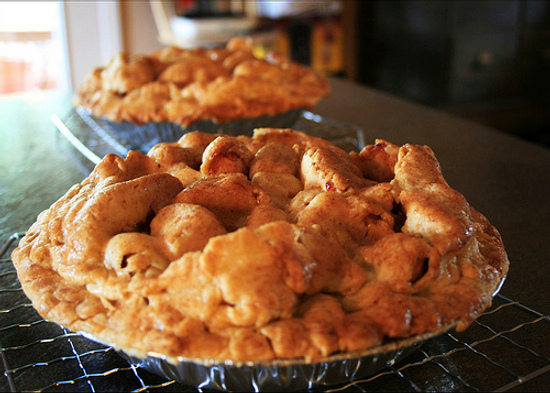
Imagine a world where the police harass an 88 year old woman for bringing homemade coconut cream pies to a church Fish Fry, a 73 year old woman for bringing raisin pies, and a 69 year old woman for bringing pumpkin pies.
Oh wait! You don’t have to imagine it. That’s the world we live in.
Earlier this week, the Wall Street Journal ran a story on the now famous Pennsylvania Pie Fight, dubbed “piegate” by some.
The crux of the story? Selling baked goods made in someone’s home kitchen is illegal — unless that person’s home happens to contain a certified commercial kitchen.
To be fair, the state will “allow” you to sell homemade baked goods if you pay $35 to have your kitchen inspected (and it passes).
“Well, that’s just ridiculous,” says Ms. Humbert, 73, one of the parish bakers. She has been bringing raisin pies to the church for more than a decade and says she thought the women’s kitchens “are probably a lot cleaner than some restaurants,” but might not meet “nitpicky” requirements. (source)
Two things:
1. It’s nearly impossible to pass an inspection without a commercial kitchen installed. That’s why it’s called a commercial kitchen.
2. Why do little old grandmas, or neighbors, or even you, need “permission” from the government to sell home baked goods anyway?
What business is it of the government’s what you do in your kitchen? If your neighbors or your church members want to pay you to make them pies, or bake a loaf of bread, or cook them dinner while they’re busy or sick, why shouldn’t they be “allowed” to reimburse you for your time & expenses?
Some object that we need certified and inspected kitchens in order to keep food “safe.” Since when is it the government’s job to make sure your kitchen is “safe”? Isn’t that your job? And if your neighbors get sick from the food you prepare, they have the right to sue you for damages if you didn’t resolve the issue to their personal satisfaction.
This is another example of the long arm of the law reaching too far, of laws written with giant businesses in mind not scaling down to the level of small-scale producers.
And what’s the end result of this kind of legislation?
We are becomingly increasingly disconnected from the food on our tables. We’ve forgotten how to cook, and some might argue we’ve forgotten how to eat. We’ve put the responsibility for feeding our children, our families, our communities, and ourselves in the hands of giant corporations who have no concern for our health and safety.
It’s time for us to take control of what we eat, fight back against the dominate food culture, and join the real food revolution — even if it means buying illegal pies from little old grandmas.
(photo by pchsfysicstchr)
 |




That is so ridiculous. I understand that the FDA needs to protect the nation’s food supplies, but it’s crazy that incredibly small producers are getting hassled while large scale food production companies (ex. peanuts) go for years without getting busted by greasing the wheels with some green…
Unbelievable… thanks for the post.
Nick
These guidelines vary considerably from state-to-state. The FDA’s model food code is pretty vague and states have interpreted it differently. In Massachusetts, it is fairly easy to get your kitchen certified for baked goods – not so easy for anything else (you do need the modifications that commercial kitchens have). Towns, not the state, are responsible for certifying.
I don’t think this one case in PA is the death knell for home cooked foods, bake sales, etc.
Linsey
Dear Uncle Sam,
You have your hands full regulating mass producers of food. You get to deal with Nestl
Nick — You’re welcome!
Linsey — I don’t think this is the death knell for home cooked foods. It’s the law of the land almost everywhere, but most places still break the law, trying to fly “under the radar.” And that’s a good thing that won’t go away anytime soon.
While it’s true that the law varies from state to state (or even town to town), it’s also true that there is something wrong with this picture. I don’t believe the state has any right to come into my home and inspect my kitchen, even if I’m producing goods for sale in it. Even if, as in MA, it’s easy to get certified, why should I have to? Why should I pay the government fee and jump through hoops just because I’m trying to be charitable and bake a few cookies for the teens at church to sell? I don’t like this level of interference in the day to day minutia of my life, and I don’t think it’s fair or just at all. Particularly when the end result is that rather than selling homemade pies, people re-sell pies they buy from the local grocery store. It’s bad enough eating those pies at holiday dinners instead of the real thing.
What this kind of law does is discourage people from being connected with their food. It encourages them to think of cooking food as a “dangerous” activity, and it makes them rely more heavily on processed crap that passes as food simply because it’s edible. And sadly, it also disintegrates the sense of connectedness we used to have preparing and enjoying community meals with our families and neighbors.
Local Nourishment — LOL!
I’d be especially sad if bake sales became outlawed. Those were always great fun and surefire fundraisers when I was in school!
Amelia of Gradually Greener
An elderly man at our parish was telling his mother’s story last weekend. She was essentially abandoned at the age of seven when she came from Syria in 1902 and worked as a farmhand until she got married. Her husband died very early leaving her to raise five children on her own. How did she survive? Did she go beg for help from Uncle Sam? No, she made food, hiked over a mountain every morning, and peddled it to the miners. She did that through until her kids grew up and could support themselves.
All I could think at the end of that was, “That would totally be illegal now. She and her progeny would have been destitute all their lives if they refused government help.”
This is interesting… in NH we are allowed to purchase a “Homesteading License” for a one time fee of $25. It allows you to sell up to $5000 in baked goods, acid based canned goods as well as jams & jellies without a commercial kitchen. No inspection required…. “Life Free or Die” (for a small fee!)
It is a sad state of affairs that the government has to have its fingers in all our “pies.”
Maggie
I guess I wasn’t clear enough about MA state law. To sell cookies at a bake sale or at church in MA (and I’m sure in other states as well), you DON’T need certification. You need certification if you want to be a wholesaler or if you want to sell baked goods in a farmer’s market.
I don’t think that’s unreasonable or onerous.
I also don’t think we can generalize this PA to every state in the US. We can speak specifically to this case and to the absurdity of the enforcement in Pennsylvania. What you say about connection to home-cooked food is true, absolutely, in this case.
A great example of how home-cooked, real food is thriving in the US is in communities where there are concentrations of Indian expats. Tiffins are still prepared by home cooks and delivered both to homes and offices around the country.
I think it is important for people to gather to eat real food as often as they possibly can. With food from their kitchens. I also think food safety is important, too. If people are going to produce food for wholesale, they should be certified. All states require that. All states do not require that grandma certifies her kitchen so she can participate in community meals. States like PA need to know that it isn’t okay to do so.
Linsey
Linsey is incorrect. You do need a local BOH inspection in MA for both a retail an/or wholesale home kitchen. You also have to take an allergy training class and pay an inspection licence fee. I just got approved, it is not as bad as it seems. My problem was my town’s BOH agent. I ended up going to my moms kitchen in a different town because of the BOH agent. If your board of health person is helpful you can learn many things and it will help down the road if you ever want to open a shop. If you get a bad BOH person they make you jump through all types of unnecessary hoops and want to shut you down before you start. I guess that is the main problem in MA each BOH agent sees things different so you might get the short end of the stick. Ask around in the local shops before you put time into a home kitchen. I think Church/school bake sales may fall under a different category just call and ask.
I have to dissent here. I’ve been in some private kitchens that horrify me. Cats licking plates clean, then a quick rinse and the dish is considered clean. Food left out for hours or overnight, then assumed to be edible. And this from people who don’t “look dirty” or anything.
I think we forget sometime just how bad sanitation was before regulation. I agree that the USDA is germ-phobic, and I worry that they have or will make things I consider healthful to be “unsafe” (raw sauerkraut, un-irradiated foods, etc.), but I don’t think all regulation like this is bad.
Amelia — I don’t think bake sales will be outlawed. In PA, the ladies from this news story could have sold their pies if they’d just made them at the church kitchen (which is certified). Or, they could have “worked around” the law by giving the pies away and accepting donations.
Linsey — Thanks for the clarification, and I couldn’t agree with you more about people gathering to eat real food.
Emily — So, if someone offered you a home baked pie, you wouldn’t accept or eat their gift unless their kitchen had been inspected? I’m just wondering where we draw the line in these sorts of cases. I, too, have been in private kitchens that horrify me, but I still think that the state of PA is definitely over-reaching when outlawing the sale of home cooked foods at this small level of production.
Kristen,
Thanks for your post and also your kindness in replying to people. My wife and I were planning to bake cookies and sell them for a little extra income, but we do live in PA and I checked their regs. I think our kitchen could pass, but they don’t allow pets in the house–at all, not only not in the kitchen. We have no pets right now (my apt doesn’t allow any) but once we move my wife wants to bring her small dog down from her parents’ in NJ). My question is: (1) do you have any idea of the penalty is in PA if you sell baked goods without inspection and (2) if we get inspected now, pre-pet, would we need to be reinspected?
Thanks again for your advocacy!
Dave
There was a big to-do about that not too long ago in our area. L-A-M-E!
What a waste of government time and money on Grandmom’s pies!!
Kara-Noel
This sort of incident is good in that it raises the visibility of what the laws are actually saying. Even though this is specific to PA, it could easily spread to other states as well. I also agree that some private kitchens are nightmares, but I should be able to decide from whom I buy my food. Why can’t the government just require labels or notices? For instance, “This pie was not made in a state certified kitchen.” Then I am assuming the responsibility for my choice. People who want their food to come from inspected kitchens are informed and can make their own choices.
As an aside, I’ve worked in restaurants and can guarantee you that some, and not small percentage, restaurant kitchens are very terrifying. The government cannot guarantee food safety. They can provide a false sense of safety.
Spinner
I agree with the idea of keeping the government out of our kitchens (and gardens).
Also, we have gotten so used to the idea of things being antiseptically clean. But this keeps us from building immunities up. Are the people with the horrific kitchens healthy? What about other countries where they cook sitting on the ground outdoors, with their small stove and all the food on the ground near them? I’m not trying to be gross here, just saying that our modern notion of “clean” that the government wants to push off on everyone, is too much. “Clean” hasn’t kept the e coli from the spinach and peanuts.
I’m with Emily on this one. And here’s where I draw the line: If I know and trust the person selling the whatevers, I am making a sonewhat informed decision to buy the product or not. I know so-and-so’s a clean freak, I know so-and-so has 12 cats who crawl around her kitchen counters, etc. If I go vsit someone’s home, I can see whether I would want to eat dinner there or not. But if I’m at a bake sale and I don’t know who or where the food came from, I’m probably not buying, sorry ladies.
And while I agree that leading an antiseptic life isn’t healthy and that “a little dirt don’t hurt”, I don’t think that a little cat hair in my pie, or a little samonella in my chicken, or a little botulism in my jelly will improve my antibodies. One is gross, and two can kill me.
Princess Edamame
This is so crazy! I believe the seller and buyer are the ones who should have the freedom of taking a risk. The seller takes the risk of selling something that may not be clean and healthy, and the buyer takes the risk of buying something that comes from a home that he knows nothing about. That Dear Uncle Sam letter is too cute!
peg
What these sweet little old ladies need to do is sell something else, say pencils. If you buy a boring, normal old #2 pencil for $15, then you get this glorious pie for free.
Or charge an admittance fee to the ‘pie viewing area,’ then you get the option of picing one for free. Of course everyone can see the pies — the fee is for the close viewing….. LOL
I HATE stupid laws.
-leo
This is just too good !! Yes indeed more than one way to get granny’s pies sold !!
hey guys look, this is not ALWAYS true!! i live in tenn and just got passed to bake and sell out of my kitchen to any state i feel like it. In any case, i dont need the fda to approve me either just a few permits and such and i was on my way!
Sorry, but here in Texas it is illegal to sell or donate for resell (such as a bake sale) ANY food item produced in ones home kitchen. It sucks. But that is the case. There is a movement trying to get this law changed here in Texas. Hoping that our fellow humans in congress can see how crazy it is, especially in these harsh economic times, to discourage an already exhisting in home business that can help boost it’s economy.
I necessarily don’t disagree with a license fee and an inspection, I also believe anyone wanting to sell food to the general public should at least take a food safety course. Just because one knows how to cook well does not mean they understand about cross contamination or temp control. So taking a course about food safety is a good idea for ANYONE even those not wanting to sell food from their home kitchen. I know I learned quite a bit from a free course that was given in the county I first became licensed in here in Texas. Yes I have a fully licensed cake company, but I am not one of those snobs that thinks it is right that the state forces us to go into debt to become legal. I have worked in restaurants and I have seen the filth that some have in abundance. The funny thing is, that in the states that do allow home baking for sell will tell you they never have a food poisoning incident from the home kitchens…it is always from the restaurants that they have a problem with. Take 10 random restaurants compared to 10 random home kitchens and I guarantee you that the home kitchens will be cleaner than the restaurants.
AMEN to that!!
Angie, I live in Texas too, and am planning to start a home-based cake baking business, but have not checked into the state requirements yet…as far as kitchen regulations/specifications are concerned. Did your kitchen have to meet the same requirements as a commercial restaurant kitchen in order for you to become licensed? I have read that the kitchen must be separate from the rest of the house, either closed off with partition or doors, but am curious about what “minimum requirements”, mentioned on the permit application, page are. I hope you don’t mind my asking, and look forward to your response. By the way, I live in Van Zandt County.
I agree with you all on this issue.. I currently have to pay to use someones kitchen in order to bake my things in order to sell and profit in a home based business, doing what I love to do.And its hard to make a living off of the earnings from my labor in a kitchen and the money put out in supplies to bake things that people want to buy. Or what they have ordered..
I wish they were a little more leiniant on home baking. Maybe a caution label, stating that The consumer and buyer knows that It was baked at home and not a certified kitchen or Bakery.
“Sweet ~Gee’s”
In an effort to change these ridiculous laws, many states’ bakers have started grouping together and writing to their lawmakers to enact Cottage Food Laws. One such state, NJ currently has a bill in the NJ Senate and needs your support. To all NJ residents, please join us at http://www.facebook.com/NJHomeBakersBill and support our efforts to have S2734 (permits sale of home-baked goods under certain conditions) passed and eventually made into law. Thank you.
-Grace DeStefano
Somerset County, NJ
This in America? Does the government doesn’t have anything to do that arresting those people who’s peacefully living? Why don’t they just go after criminals and robbers? At least they deserved to be arrested.
I am presently trying to persue a home baking business in Va. and it has been almost impossible….one day they say do this and the next day its do something else. I have cooked and baked for over 50 years, served as Womens director of churchs, had a daycare for over 30 years, have had a food license for 17 years, and just completed all classes for ServSafe certification for resturant manager, caterer, etc…….and still having problems with the health dept. with their rules and regulations. They keep telling me different things on the phone but getting them into your kitchen to inspect is another story. I have decided to apply through the USDA and have them come and certify my kitchen and then the health dept. will not have any jurisdiction.
I’m trying to launch a cottage foods hot sauce business in Seattle and every time I talk to the FDA, the county health dept and the commercial rental kitchens it seems the price of everything goes up. Just to get licensing/approvals/inspections, I’m looking at thousands of dollars. Not to mention that the rental kitchens want me to carry $500,000 in liability insurance before they’ll even let me tour the place. It’s a vicious circle. I can’t get approval until I rent a kitchen. I can’t rent a kitchen until I get approval. As of now, I’m asking for a small donation per bottle to help cover my costs so as to avoid the red tape.
This article is so interesting!!!! Never thought of it this way!!! I couldn’t agree with you more! I’m thinking of making macaroons from scratch. It’s a lot of work, boiling whole almonds, taking the skin off, drying them in the sun, grinding them many times in the tiny coffee maker, then making the meringue and so on… But I enjoy doing it and I want to encourage people to eat food that hasn’t been processed. When I thought of selling them, I thought of getting infos to see what I need to make them in my kitchen. When I went to the Massachusetts board of health dept website, I was discouraged. It’s just too complicated. I have a clean kitchen, a clean fridge, but I can’t build a commercial kitchen. So I gave up my project!
When I think of my father who was never sick, how he never washed his hands, never washed his vegetables and fruits. I remember he used to eat old food that we could never touch and he never got sick. And now the more we wash our hands, the more we freak out about germs, the more we’re sick.
Again thank you so much for your article. It opened my eyes on a lot of things.
Lila
so, is it REALLY TRUE that you can prepare foods from home (I’m definitely thinking like lunch foods) and then only suggesting a donation will keep you from getting harrassed? I have been cooking meals on Sundays for my husband’s workcrew (because he hired them with a certain pay PLUS he would take care of their food) to last until Fridays. I have gotten nothing BUT raves and awesome exclamations and SUCH appreciation for my home-cooked food. Of COURSE these guys aren’t going to look into whether or not I’m licensed…they LOVE IT!!!! (apparently, their wives don’t really cook) SOOOO, if I make some of the same and go around to just a few businesses in town with my wares around lunchtime, or call ahead and take their “order” of the things I made, could I REALLY just suggest a donation and be safe from the scrutiny of the red tape? or is this just talk? Thanks! 🙂
…OR the whole “sell a pencil for $15 and get the pie for FREE!” deal…whichever
Keep in mind… If even one person get sick (even if the reason had nothing to do with your food) and thinks it was your food.. or has an allergic reaction and reports you to health dpt.. you could possibly get into trouble.. besides they could probably sue your pants off…
Well… There is a lot of grey area… But the fact is, people do die from mishandled food.. and how would you feel if your 6 yr old got sick eating a home made cookie you picked up at the store thinking it was safe and regulated.. and then, of course, where do we draw the line.. even non hazardous food can be exposed to hazardous substances.. better safe than sorry, i always say, when it comes to food..
Well… There is a lot of grey area… But the fact is, people do die from mishandled food.. and how would you feel if your 6 yr old got sick eating a home made cookie you picked up at the store thinking it was safe and regulated.. and then, of course, where do we draw the line.. even non hazardous food can be exposed to hazardous substances.. better safe than sorry, i always say, when it comes to food..
Well, to be honest, more people die from regulated food and/or medicine than anyone has ever died from eating homemade foods/preparations. All the prepackaged, over-processed foods that millions upon millions purchase everyday is more hazardous to your health. I know how to handle food….it’s a shame a few scant mishaps from careless people have ruined it for the rest of us.
I live in Massachusetts. I bake for a local Food Bank once a month and also for weekly dinners at the same church when I can. I have no permits, etc. but my kitchen is clean – I do not charge the church, I do it to help those in need.
My grandmother used to say two things, what does not kill you makes you stronger and you have to eat a peck of dirt before you die LOL
I don’t buy bake sale items as I am usually the one baking for the sales. Also, wearing gloves is worse than using your bare hands at least in my book.
Thanks for the Blog post spreading the word. Our country disgust me.
Now I want some illegal pies….
I’ll make them for you for the price of a pencil 😉
What is really interesting is that I have gotten sick from eating at restaurants where food hadn’t been prepared properly, but I have never gotten sick from something I have made in my “uncertified” kitchen.
What’s up, every time i used to check blog posts here early
in the morning, as i like to learn more and more.
whoah this blog is great i love studying your posts. Stay
up the great work! You already know, many people are looking round for this
information, you could aid them greatly.
I make homemade biscuits. I want to sell them for $1.00 each at the Farmer’s Market. I want to fry sausage to put on them, wrap them with foil sandwich wrap and keep them hot in a crock pot. Can I do this?
It bothers me seeing all this stuff that’s out dated when the cottage laws have been updated since them. Like for Texas, those laws were changed September 2013. Stating you can pretty much sell anything that does not need refrigeration
Actually it varies. In Ohio they can and do sell their food products and you dont need an inspection.
There are however a few rules.
You cant sell something that needs refrigeration. Therefore the cream pies would be out.
Its easier to look for the “Cottage food laws” for your state.
Cottage food laws are a thing…not all baked goods are illegal to sell.
I run a small but successful cookie business out of my home and paying a small fee plus an annual inspection is a small price to pay for low overhead, complete control over my work environment, and modest profits. Yes, I have been in some horrible home kitchens and am also very particular about what my children eat and from where. My customers appreciate the fact that I am not only dedicated to but responsible for maintaining a clean kitchen. We who sell food out of our home legally are providing all the goodness of homemade while being mindful of the need to be conscientiously clean. The public should be grateful we provide this option and grateful to the local governments who facilitate this, keeping both the supplier and the consumer in mind.
The government wants to have their hand in absolutely everything we do! It’s just one more way to tax the citizens.