
Perhaps my biggest pet peeve is seeing food marketed as “healthy” or “natural” that is anything BUT those things. How can they label bubble-gum flavored apples “100% Natural”?
Of course, I know how. “Natural” is a regulated term that just means derived from nature rather than totally synthesized. But it does not, in any way, mean that the food is presented as it is in nature, or in a way we’ve traditionally prepared it. Hence, we can have “natural” orange juice that has been vat stored for up to a year and had “natural” flavorings added back into it since it would otherwise be flavorless.
“Healthy” is just as ambiguous a term in food marketing. But we buy into it. Over and over.
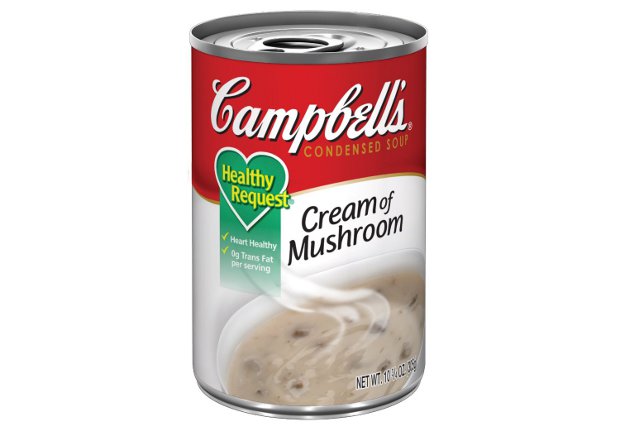
Case in point? Campbell’s Healthy Request Cream of Mushroom Soup. It says it’s healthy right there on the label. But is it really?
Here’s what the manufacturer claims:
Campbell’s® Healthy Request® condensed Cream of Mushroom soup offers the rich traditional flavor of Cream of Mushroom soup with a more nutritious profile. Great taste made with lower sodium natural sea salt, 98% fat free, 0 grams trans fat, no added MSG, and 480 mg of Sodium per serving. Good source of Calcium.
This soup is part of our Wellness Collection.
It’s got the name “Healthy” right on the label! It’s “more nutritious”! It’s made with “natural sea salt,” has “no added MSG,” and “0 grams of trans fat”! These are all good things…. I think.
Campbell’s Healthy Request Cream of Mushroom Soup: Ingredients
- WATER,
- MUSHROOMS,
- MODIFIED FOOD STARCH,
- WHEAT FLOUR,
- VEGETABLE OIL (CORN, COTTONSEED, CANOLA, AND/OR SOYBEAN),
- SUGAR,
- SOY PROTEIN CONCENTRATE,
- CREAM (MILK),
- SALT,
- POTASSIUM CHLORIDE,
- FLAVORING,
- LOWER SODIUM NATURAL SEA SALT,
- CALCIUM CARBONATE,
- DISODIUM GUANYLATE,
- DISODIUM INOSINATE,
- DEHYDRATED MUSHROOMS
Campbell’s Healthy Request Cream of Mushroom Soup: DECODED
Water and mushrooms need little explanation. We could get picky and ask if it’s clean water and organic mushrooms, but let’s not. Okay?
Modified food starch is a heavily-processed ingredient used as a thickening agent, stabilizer, and emulsifier. It can be made from any number of starchy foods, including corn, wheat, or tapioca. The consensus seems to be that it’s relatively harmless. However, if you’re gluten-sensitive, you’ll want to avoid it unless it’s explicitly labeled “gluten-free.” Also, if it’s made from corn, there’s a 88% chance it’s genetically-modified corn with built-in pesticides and other “goodies.” It’s also likely that modified food starch hides MSG, although this may not always be true for all cases.
Wheat flour is a refined flour with added synthetic vitamins and minerals. While this may not be best for you, it’s also not especially concerning. Many foods are made with refined flours, and this is in low enough quantities that I suspect it’s only here to be a thickener.
Vegetable oil is definitely one of those totally gross products of the industrialization of our food supply that I wish our culture would entirely abandon. Corn, cottonseed, canola, and soybean oil are all highly likely to be from genetically-modified plants. But the real kicker here is that these industrially-produced oils are completely unnatural and new to the human diet:
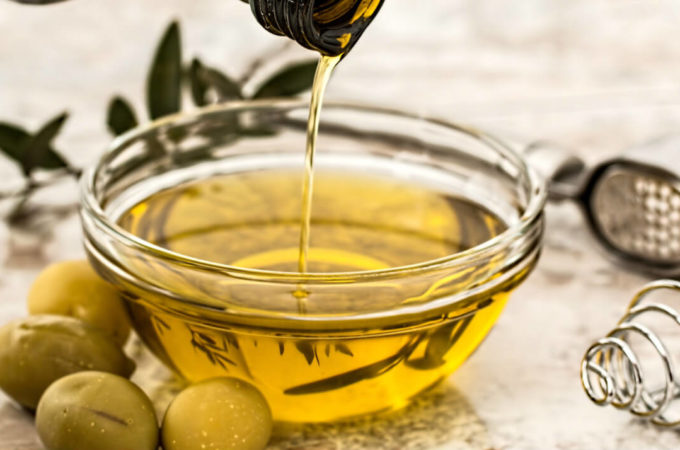
You see, prior to the industrial revolution, making seed-based cooking oils was far too labor intensive and (in many cases) downright impossible. All the ancient cooking oils (like coconut oil, palm oil, olive oil, etc.) are easily pressed out of the plant without needing extremely high-pressure or high-temperature extraction.
After the industrial revolution, we had the technology necessary to create modern seed-based cooking oils. So, we did.
But the process of making and refining these oils translates into one thing: rancid polyunsaturated fatty acids (PUFAs). PUFAs don’t hold up well to heat or pressure. The same is true for both organic canola and organic soy oil. Soybean oil is roughly 58% polyunsaturated fatty acids — nearly twice that of canola! So, in the process of being extracted from the seed, these oils oxidize and many of them plasticize (turn into trans fats). The end result is stinky and unappetizing, so the oil is further “cleaned” using bleach or alternative chemicals to deodorize it.
(source)
Sugar refers to refined table sugar, and it likely comes from genetically-modified sugar beets.
Soy protein concentrate is an industrial waste product.
Let’s be clear on the recent history of soy. The soybean was a modest and unpopular crop until food manufacturers intent on creating cheap vegetable oils convinced the U.S. government to start subsidizing it. The soy was turned into oil, and the industry was left with an industrial waste product. Then somebody had a brilliant idea:
Let’s take this industrial waste product full of toxins and carcinogens — isolated soy protein — and turn it into food that people will eat!
(source)
In fact, isolated soy proteins do not even carry the “Generally Recognized as Safe” (GRAS) status which seems to be so freely handed out by the FDA.
The FDA refused to approve isolated soy protein as a safe food additive with the designation “Generally Recognized as Safe.”
Agribusiness giant Archer Daniels Midland withdrew its application for the coveted GRAS status for soy protein, after an outcry from scientists about the toxins and carcinogens that come with it. They can still put soy protein in your food, but they have to get pre-market approval for every product.
Isolated soy protein is no health food.
(source)
So, whenever you read “soy protein,” think: industrial waste product full of toxins and carcinogens. Then, don’t eat it!
Cream (milk) is surprisingly low on this ingredient list, considering that in any homemade cream of mushroom soup it would be the number two ingredient, right behind homemade broth. That alone is a warning sign that this food is more fake than real.
Salt is here to add flavor, as are potassium chloride, flavoring, and low-sodium natural sea salt. Potassium chloride is often used in food processing as a sodium-free salt. Since this is the “healthy” version of this Campbell’s soup, it makes sense they’re trying to reduce the sodium levels of the food.
Flavoring is one of those warning-flag ingredients because it often hides MSG. (Read more about why MSG is dangerous.) In this case, I’m entirely certain it does.
Want to know how? It’s those other two ingredients — the disodium inosinate and disodium guanylate. These food additives are completely ineffective and useless without MSG! These are flavor enhancers that work in conjunction with MSG. There’s absolutely no reason for them to be there unless MSG is also there.
Unfortunately, it’s perfectly legal for a company to say their food product has “No added MSG” so long as they don’t add an ingredient called “monosodium glutamate” to their food. MSG, however, hides in more than 40 commonly used ingredients in industrial food — ingredients like flavoring. This means MSG can sneak up on you in a whole host of foods that don’t technically have a single ingredient called monosodium glutamate listed on their label. (source)
For more on where MSG may be hiding in your food labels, I’ve created a handy, downloadable, easy-to-print guide for you.
Calcium carbonate is used in a host of industrial applications. In food, it can be used as a calcium supplement, and is approved for use as an a acidity regulator, anticaking agent, stabilizer or color.
Last, but not least, we have dehydrated mushrooms. I don’t think I’ve got anything to say about these! (SHOCKING, I know.)
Campbell’s Healthy Request Cream of Mushroom Soup: THE VERDICT
So, what should you use instead?
Of course, the best option is to make your own cream of mushroom soup. I’ve been making this delicious recipe from Chef John for years.
Here’s a video which demonstrates just how straightforward his recipe is. (You’ll still need to go to the recipe for the complete ingredient list, though.)
Want Your Labels Decoded?
In this series on Decoding Labels, I’m highlighting deceptive labeling practices, hidden ingredients, and more! If you’ve got a particular label pet-peeve you’d like me to share, please feel free to email me with your idea. It may just turn into a blog post!
 |




And this is why I rarely by anything in cans, boxes or prepackaged anymore. It is just so bad for you!
It surprises me how much people trust labels. Someone recently said they were buying their daughter cheerios because she is having health issues. I asked why on earth she would think that cheerios would be a good choice. She said… Because it says so on the box
Cheerios make me so ill. As I have gotten older, I have had to radically change my diet. Of course, older mean hopefully wiser, so I need to stop eating all that processed food anyway.
WOW. I find that deeply disturbing. It *almost* makes me wish that food marketing health claims could be banned. But then, how would people ever learn about the health benefits of REALLY healthy foods like coconut oil?
Wa! It seems delicious and nutritious. I will buy it if I see them in the supermarket.
Great article, people need to seriously think about the ingredients in their food. I am down to only buying two canned food items beans, which I just found a recipe for and tuna which is going soon as you cannot trust even that anymore. Make your own folks it is not hard or that time consuming.
One more thing Chef John is the best.
He is fun, isn’t he? And I like that he uses *mostly* real ingredients although he has a few doozies in his repertoire from sponsors that weren’t all that healthy.
Disgusting!
For me the Campbells label says it all- it says stay away ( :
I grew up on Campbell’s soups. ……most of my
generation did. I am sure that those red and white
cans meant comfort food to all of us and as young
adults and parents; healthy food for our families.
The best foods are those we grow ourselves.
We are trying to not buy canned or packaged foods
and as local or organic as possible . Our greenhouse
gets constructed as soon as weather permits ( we live
at 7800′ feet in Wyoming)
Thank you for information and recipes
Kate
We’re at 4500 in Wyoming. So nice to find a fellow reader. No room for a greenhouse in our yard, but I’m planning veggie gardens this summer.
I’m so glad I came across your website. This is very helpful information. Thanks for doing this work to educate others. I’m sharing this with my mom who thinks I’m crazy for being worried about processed food. Hopefully she takes the time to read it.
Great service…clarifying labels and ingredients is a wonderful service for all of us MAHALO!
When I see our school lunch menu posted online I see “Tater Tot Casserole” quite often. Thats canned soup, frozen tater tots and pink-slime beef. (Our school board chose to keep pink slime at the insistence of local politicians who get big campaign bucks from the beef-ish industry.)
Even if they use the “Healthier” versions of the packaged ingredients, that is still a chemical shit-storm for every freaking kid in the school who did not pack a lunch that day. What’s the attention span like on those afternoons? Are their behaviour problems in every classroom? Notes home begging parents to put their kids on ritalin?
It is a quandary! I read an article a few years ago about a principle who banned sugar from her school and saw an immediate and noticeable improvement in student participation, behavior, and test levels. She also worked out a deal with local farms to get fresh veggies for her cafeteria staff to cook with. It wasn’t 100% real food by any means, but it was a big enough change to make an obvious difference.
We used to live in Japan and my son attended an international school of mostly Japanese students with a sprinkling of American kids. The principal said that they noticed a huge difference in how the American kids acted after their lunch compared to the Japanese diet. It was so bad that they banned sugar and juices from the school. Only water or green tea was allowed and no sugary foods. He said the American kids’ behavior changed quite a bit, although there was still room for improvement. It always dumbfounds me why we are so complacent in America with overly processed, crap food, when it is forbidden or greatly restricted in other countries.
That’s just plain gross! Sad something as poor of quality can be sold and passed off as food, let alone “healthy” food.
i trying to find what velveeta is made of ,i saw the article on your cheese dips,…so im wondering what ive been eating..cant be good… truly does not look like cheese… you do know that block cheese was somthing the goverment handed out to the poor.. maybe they still do….. hmmmm……
I just stumbled across this website. And boy am I ever glad I did!
I mean wow…. I knew that it wasn’t healthy, but I didn’t realize just how sneaky they can be!
Thanks for this post!
I’m definitely going to have to start reading the labels even closer than I already do!
No matter what you decide to do, all the plants, all our animals, everything is covered with and has absorbed mercury because of the fallout from fossil fuel use. I won’t even go into the products from the sea which is full “to the brim” with mercury.
There seems to be very little hope no matter the precautions one might take.
Why must I moderate my comment. There is nothing wrong or incorrect in my statement. It is fact. If you cannot accept that, well too bad for all of us.
All comments by first time commenters are held in a queue for me to approve. It’s just one more step I take to prevent spam. It should not happen to you again unless you post a comment with a hyperlink in it. Those do tend to get caught in my spam filter, which I hardly ever check!
Thanks for commenting. 🙂
This is a really awesome assessment that can be applied to most packaged, processed foods. It’s bewildering that food companies are allowed to make these deceptive claims because that’s what most people go by when picking up foods. “Hey, the label says it’s good for my heart so it must be true…”
I’m totally, 100% on the same page as you … wish there were more of us out there. Keep fighting the good fight!
Wow… Thank you so much for educating us.
Love this! Even before I knew a thing about real food and was still eating a mostly SAD diet, I knew that cream of anything soup in a recipe meant the recipe was pretty gross. Slapping a “healthy” label on it doesn’t make it so!
I have lived in the US for the last 12 years and I have NEVER had Campbell’s soup. It’s just not right to eat soup out of a can. WE eat soup at our home at least 2 x a week and I always make it from scratch. How hard can it be people?? Just sautee some vegetables add water or homemade stock and you got soup!!! Seriously!!
Thank you for all the info about Campbells soup. So disappointing, as another reader stated, we grew up on this famous and trusted soup.
I stopped using processed foods over 1 year ago and 5 months ago went gluten free. BIG difference in how I feel.
It’s sad that the USA has come to this. Everything revolves around the almighty dollar, nothing else matters to the food corporations.
Keep up the good work, I am glad I found your site, thanks to Organic Gardening magazine.
Campbells calling anything ‘natural’ is funny.
Just a heads up, the term ‘natural’ when used on foods produced and sold in the US really has no distinct meaning, which is why food companies can slap it on whatever they’ve decided they think is ‘natural’.
I read in the book “Death by Supermarket” that anyone can put the “heart healthy” (or any of the the other “healthy” monikers you see out there) label on their product for a price. I think it was like 75 grand and they can put it on twinkies if they want to. Its disgusting. I don’t even go to the regular grocery store any more. I feel like it is filled with lies!
Very Very informative about the cream of mushroom soup. Keep up the good work. Love you site.
Just thought I would share that I contacted Campbell’s about their Cream of Mushroom Soup. They definitely use MSG in them. I have a severe allergy and called to confirm. This is how they can put garbage ingredients and have something keep for so long. MSG is not good your you. I called 9/2013 so this is very recent info. The only healthy soup is the one you make yourself.
All things considered, I’m feeling quite hopeful for the future of good, healthy food production and truth in advertising for commercial foods. I’d like to encourage everyone who is interested in supporting this paradigm shift to stay vigilant, stay educated and most important of all make the important noises. Those of contacting the powers that be in order to have your thoughts known and added to this growing herd of the truly informed. And as is my stand with politics and religion, be the best advocate for change that you can be by using your intellect, your knowledge and your commitment but not your raw emotions. No one listens to griping, complaining, hand wringing, finger pointing and accusations. WE THE PEOPLE are the foot soldiers for change and we always have been so I believe the way to change something is to no longer accept that which has become unacceptable. We accomplish that by being the change we seek (I stole that from somewhere) Boycott the supermarkets, do your homework concerning those foods you are eating and which absolutely must be fully organic and where to buy them affordably. If you can’t afford it, change what you are eating to that which you can afford. And finally, we should measure our conversations with others for maximum impact (approaching the subject of food and food processes with knowledge and a desire to help others do the same. Rather like walking softly and carrying a big stick (stole that one too). I learned this kinder, gentler approach to bringing about change from my daughter who made me realize that my anger and indignation was just alienating the people I was trying to help. I’m so thankful for this website and I look forward to utilizing its offerings regularly.
To replace, I make white sauce with dried mushroom powder (when the mushrooms are on sale I dehydrate them, then grind them). Much better flavor and healthy!
I make my own from scratch.
I saw that label once…and winced……my mom used it as well…a lot and cream of chicken soup.
I make 2 cups of thick white sauce(gravy) to which I add sautéed mushrooms. It’s easy: 4T butter & 4T flour per 1C full fat milk with 1/4t salt — double it for 2Cs; use like canned condensed soup.
For the once a year I use it (“green bean glop” for Thanksgiving), I use Pacific’s version. I have done the white-sauce-with-mushrooms thing and just don’t like it for that purpose, it doesn’t taste at all right.
There are lots of unsubstantiated comments in your allegations, including the msg/disodium guanylate description, that soy protein is toxic waste, that soy oils are rancid and bleached. Caution you that you are subject to being sued. Your comments come off as ranting, not scientific analysis.
interesting read. Although, I doubt your expertise.
Soy Protein, is the key in how MSG is formed once the cooking process begins. You have stated that it is an industrial waste. Yes and No. Soy Protein can also be categorically recognized as a mass produced ingredient. Soy has glutamic acid and glutamine. Two components that can break down and combine with sodium creating semi “natural coccuring”” MSG in the food.
This is how they get away with the “No Added MSG” BS. They just science around it.
Back to the natural occuring concept. Here is the thing. There is no valid evidence that has been able to be reproduced without tampering, that 100% states MSG is bad for you. There is no evidence that it isn’t bad for you either. In many natural occuring instances does food generate MSG. Cheese + salt = MSG. Tomato + salt = MSG. Mushroom + salt = MSG. The ammount is aribtrarily small in consideration to what industry products artifically put in. That doesn’t change the fact though, that MSG has always been an occuring compound in cooking, and it also naturally occurs in the human body as well.
I won’t tell you MSG is good for you, but I will tell you that MSG is not bad for you.