
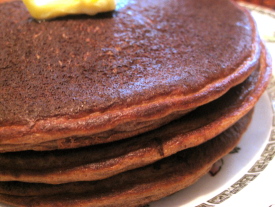
 Made from fresh whole grains, real cultured buttermilk, and you don’t even need a grain grinder.
Why fresh grains?
Because you’ll become addicted, that’s why. When you buy whole grain flour at the store, particularly wheat flour, you’ll notice something — it’s bitter.
That’s oxidation at work. Once the grain is ground into flour, it immediately starts to oxidize.
Experts say it takes 6 months for whole wheat flour to go rancid.
A person who grinds it fresh will tell you it starts to “turn” in as little as a week.
That’s because real freshly ground flour isn’t bitter. It’s sweet.
What happened to eating less grains?
Oh, that.
I still don’t eat very many grains, and when I do I still make sure they’re sprouted, soaked, or fermented. Pancakes are a rare indulgence. This is how we make them.
The Players
- 1 cup whole grain kernels (I’m using wheat kernels here, but you can use 1/2 rolled oats and 1/2 kamut for all the difference it will make to this recipe.)
- 1 cup cultured buttermilk
- 1 tsp vanilla
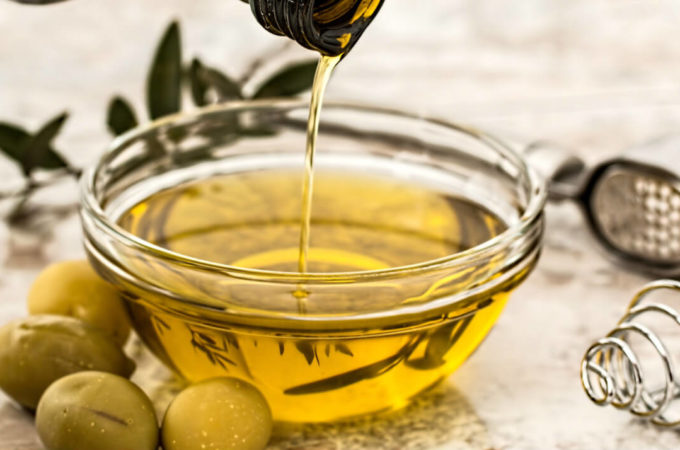
- 1 tsp olive oil (where to buy REAL olive oil)
- 1 egg
- 1 cup of milk (raw is best!)
- 1 tsp cinnamon
- 1 tsp salt
- 1 Tbsp. baking soda
The How-To
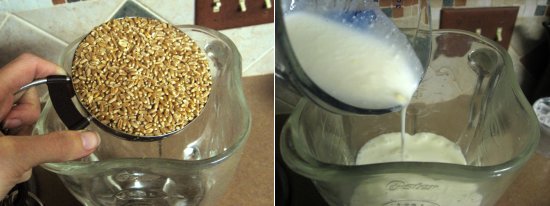
The night before you want to eat pancakes for breakfast, put 1cup of whole grains and 1 cup of buttermilk into your blender.
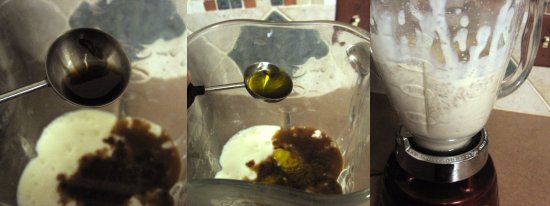
Add the vanilla and oil, then start your blender! Blend for a good 3 minutes or so unless you’re blessed with an awesome, over-the-top, spectacular, show-stopping blender like the VitaMix that doubles as a grain grinder and ice cream maker because of it’s power and durability. If you’ve got one of those, you probably only need to blend this for a minute or so.
Now, let this concoction soak overnight.
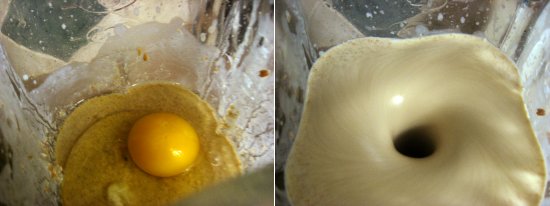
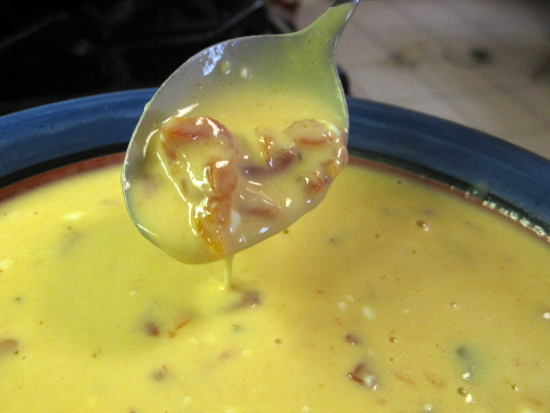
In the morning, begin heating your griddle or skillet to medium-high heat. Add an egg, 1 cup of milk, and blend again. If you don’t see this whirling vortex of whole grain batter bliss, add more milk until you do.
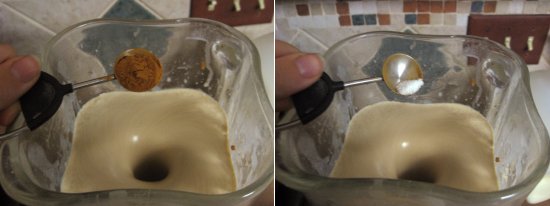
Add cinnamon and salt directly into the vortex whole. This helps avoid clumping.
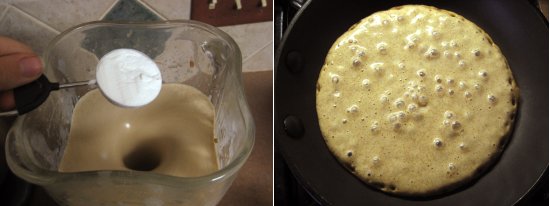
Add in your baking soda (again straight into the vortex).
 |







Looks fantastic – and easy. Sourdough pancakes are a big hit in this house.
Jenny
Food renegade, thanks for your insightful comment on my blog about raw milk for the lactose-intolerant – I feel my wisdom took a quantum leap! And I love this recipe. I did not know about grains losing their vitality after being ground. But of course – it makes sense.
I like the step-by-step pictures. But is that a teaspoon of vanilla/oil – it looks like a ladle not a teaspoon – perspective, eh?! And – do the grains in your recipe start the sprouting process during the overnight- buttermilk stage?
Thanks – you are a renegade after my own heart!
Elisabeth
So in that first picture, you have just dry whole grains? And they blend up eventually into a smooth batter? I find this exciting and hard to believe! Thanks for stopping by my blog. I’m loving your sso far!
Michelle @ What Does Your Body Good?
Elisabeth — yes, it really is a teaspoon! To answer your question, the grains don’t sprout, but soaking them in buttermilk (or another acidic medium) overnight will neutralize the phytic acid in the grain and make it more digestible.
Michelle — Yep. Just dry whole grains, and they blend into a nice smooth batter after soaking them overnight in buttermilk.
This sounds delicious – thanks for sharing! I’m going to try this recipe this weekend.
Juliet
I just made these and they turned out tasting GREAT! However, my batch made some REALLY thin pancakes…i dont even know they can still be called pancakes they are so thin, lol.
Any suggestions on how to thicken them up? More flour, more baking soda, less buttermilk or milk maybe?
Hi Tamara — First, I notice you said “flour.” There is no flour in this recipe. Could that have been your mistake? I start with whole grain kernels, not flour.
To get the same consistency out of flour, you would need about 2.5 cups.
Assuming that you didn’t make that mistake, though, and that you followed the recipe the first thing I would try is adding less milk. I generally add mine quite slowly just until the vortex forms. That’s usually about a cup for me, which is why I put that in the recipe.
As for why you ended up with crepes? Your buttermilk could have been thinner than mine, your egg less firm (particularly if it’s not from pastured hens), or your baking soda weaker/older. Or, it could just be a difference in altitude/barometric pressure.
Let me know how it turns out next time!
This looks wonderful! Thanks for this. I’m currently looking for alternatives for breakfasts.
Emma
I have just discovered your site and am enjoying reading it through. I’m learning about soaking grains etc – never knew about this before recently reading Nourishing Traditions and your site.
I have made pancakes in a similar way – grinding them in the blender. I used soft wheat berries (you can get organic white soft berries through Bob’s Red Mill) which will grind up easier than hard winter wheat. The last time I made these pancakes I added some almond meal to thicken up the pancakes a bit. I look forward to trying my recipe by soaking the grain the night before. Thanks for this recipe.
Made these this morning from 3/4 spelt and 1/4 barley – so yummy! They’re thinner than our favorite pancake recipe, but the cinnamon really made my day. Thanks for the recipe! (We figured if it makes 30 pancakes, by the way, each pancake is about 30 calories, if anyone cares.)
Katie @ Kitchen Stewardship
I’m trying this recipe this morning, and when I came back to it after letting it soak on the counter overnight, a dark film had formed on top. Is that a bad thing? Was I supposed to refrigerate it? It was about 65 degrees in my kitchen overnight.
Well, we mixed them up and ate them, and they were terrific! We used a 1/4c less milk, and might use a touch less salt… But they were sooo delicate and delicious! Thanks for educating me about the ability of blenders to grind flour. What a neat trick!
Is there a typo in this recipe? 1 TBSP of baking soda is a lot of leavener. Makes the pancakes too spongey and salty too. Also, 1 cup of milk makes them too thin. I’ve had better results making these mods: 1 TSP baking soda, 1/2 tsp. salt, just enough milk to thin it to your liking (in my case it’s about 1/4 C)
I followed this recipe with the oats and kamut, and I have to agree that one cup of milk is way to much.
I got a batter so thin that the pancakes ended up more like crepes and were nearly impossible to flip. Also, the baking soda was also a bit much, the pancakes even though very misshapen were still very tasty except for a baking soda aftertaste..
The flavor of these is really good though, I’m gonna try making these again with less milk and less baking soda and see how they end up!
I made these for breakfast this morning. I should have read the other comments before attempting them as I would have added WAY less milk. The batter is very thin, which makes them difficult to flip. I ended up with very thin crepes as well. Anyway, never a quitter, I simply took my crepes and spread them with a little homemade peanut butter and a drizzle of honey and made pancake “roll-ups”, which my 7-year-old son devoured. I’ll definitely make these again, but I will use 1/2 the milk the recipe calls for.
Thanks for the awesome site, btw!!
Hi! I love this recipe and have a question about it. I was wondering about the tablespoon of baking soda, is it really supposed to be that much? It makes the pancakes taste really salty. I reduced it to 1 1/2 tsp which doesn’t make the salt taste quite so overwhelming? Any thoughts on this? 🙂
Just wanted to say that I made these this morning, and I followed the recipe along with the suggestions in the comments – 1 tsp baking soda, somewhere between 1/4 and 1/3 cup milk (and we used almond milk since that’s all we had), and slightly less salt than listed and they turned out WONDERFULLY. Easily the best pancakes I have ever had. Thank you for sharing!!
I made these for breakfast recently and they were delicious! I used homemade buttermilk and soft winter wheat berries. I added about 1/2 cup of milk instead of a whole cup and I omitted the cinnamon (I was all out). I think they’re the best pancakes I’ve ever had. Thanks for the recipe!
Thanks for the recipe – my 2 year old is enjoying them as I write… I used 1 tsp. soda, less than 1 tsp. salt, and about .5 cup milk. based on comments. thanks again!
Great recipe. Thanks! However, I want to point out something with regards to whole wheat flour going rancid. In India, we use whole wheat flour to make rotis (flatbread) and a variety of dishes. It NEVER goes rancid or tastes bitter in a week’s time. In fact, we store whole wheat flour in stainless steel bins for months and it never goes bad. You know why? It’s because Indian wheat is hard white wheat where the outer layer doesn’t contain tannins and phenolic acid. But, red wheat (popular in America) contains these tannins and is bitter in taste. So if you prefer to use whole wheat flour that is not bitter, buy the hard white wheat flour (available in all Indian grocery stores). Thanks
Pretty nice post. I just stumbled upon your weblog and wanted to say that I have
truly enjoyed surfing around your blog posts. After all I’ll be subscribing to your rss feed and I hope you write again soon!
Any idea what combination of gluten free grains might work with this recipe? I’d love to try it for our family but my husband has celiac so I need to substitute..
Thanks!
I just tried some of these at a friend’s house last night and she made them with buckwheat (which isn’t a grain, it’s a vegetable) They were DELICIOUS and I’ve been craving them. 🙂
I’m LOVIN’ the blender idea! It really cuts down on the dirty dishes! I am SO trying this.
I am intersted in making these. Could you tell me where you buy your wheat berries? Thank you!
OMG, I love these pancakes. I use a variety of whole kernel grains from Whole Foods, then grind them in my food processor and soak in the buttermilk as indicated. These taste exactly like the buttermilk pancakes at one of my favorite restaurants, Ohana’s Cafe in Ozona, FL. They serve all kinds of healthful whole food.
Will this work with ANY milk, or does it need B-Milk.