
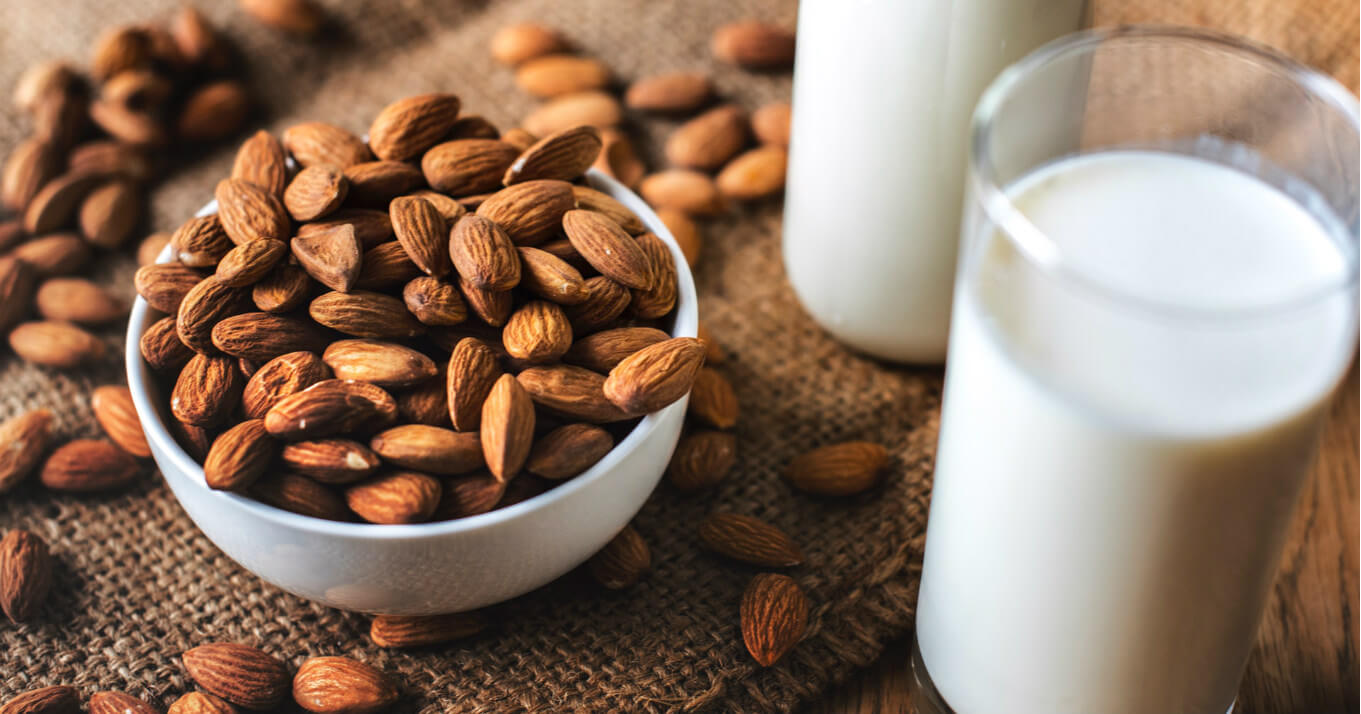
Are you in need of a healthy milk substitute? Are you dairy intolerant and in search of good alternatives to milk? Or perhaps you can’t get your hands on any milk from grass-fed cows — pasteurized or raw? Or maybe you’re fasting from dairy for religious or health reasons and simply want the most nourishing milk substitute you can find?
These days, people turn to soy milk. Even if you’re not turned off by the fact that it’s an industrial waste product spun by marketers into a so-called “health food,” you can’t like the numerous health-risks associated with soy.
So, if you’re not willing to drink soy milk, what’s left for you? What are the healthiest milk substitutes available?
Healthy Milk Substitutes
If you need a vegan alternative to soy milk, the only options out there are rice milk, nut milk (like almond milk), and coconut milk. Rice milk, although not bad for you, is also not particularly nutrient dense. It’s high in starches and sugars, and very low in protein and fat.
That leaves almond milk and coconut milk.
Almond milk has a long and interesting history in culinary circles:
In the Middle Ages, animal milk was, of course, not refrigerated, and fresh milk did not stay fresh for long. Most cooks simply did not use much milk as the short shelf-life of the product made it a difficult ingredient to depend upon. Many recipe collections of the time advise that cooks should only rely on milk that comes directly from a cow, something not possible at all times, and purchasing milk was a dubious practice, for streetsellers of milk often sold wares that were either spoiled or diluted with water. Milk’s use had to be immediate, in cooking or by turning into cheese & butter. It was these difficulties that forced Medieval cooks to look upon milk with great reluctance, and so having milk in the kitchen was usually unheard of.
Rather than animal milk, Medieval cooks turned to something they could depend upon, and that was the milky liquid produced by grinding almonds or walnuts. This liquid, high in natural fats, could be prepared fresh whenever needed in whatever quantities. It also could be made well ahead of time and stored with no danger of degeneration. Because of its high fat content, it, like animal milk, could be churned into butter, and because it was not animal milk, it could be used and consumed during Church designated meatless days.
(source)
If you do choose to go for a nut milk such as almond milk, it’s best to make it at home. Store bought almond milks usually contain added sugars, preservatives, and stabilizers. Plus, almonds also contain the anti-nutrient phytic acid which can block mineral absorption. You can neutralize the phytic acid by soaking the almonds overnight — something you’re not likely to be able to find in store-bought versions.
Coconut milk, of course, is as old as coconuts. Coconuts are high in good saturated fats, lauric acid, and the beautiful, easy-to-digest medium-chain fatty acids that actually help speed up your metabolism. Coconuts also have anti-fungal and anti-viral properties.
If choosing between coconut milk and almond milk, opt for the coconut milk.
But, you say, what about all that fat? Coconut milk is so much more calorie-dense and full of fat than whole milk, how can it be a good substitute? Did you know you can whip together a coconut milk tonic that has roughly the same nutrient profile as whole milk (same calories, same calcium, with more iron & vitamin C)? Sally Fallon and Mary Enig share just such a recipe in their book Eat Fat, Lose Fat (included below).
Here are the recipes I use to make coconut milk tonic and raw almond milk:
Coconut Milk Tonic
The Players
1 can whole coconut milk (where to find coconut milk)
2 1/4 cups water (or coconut water)
2 tablespoons maple syrup (or a pinch of stevia) (where to find maple syrup)
1 teaspoon pure vanilla extract (where to find vanilla)
1 teaspoon dolomite powder (for calcium)
The How-To
Mix all ingredients together in a medium saucepan over medium-low heat and heat until warm and dolomite is dissolved. Cool before serving.
Homemade Raw Almond Milk
The Players
1 1/2 cups of raw almonds, soaked in water overnight (where to find raw almonds)
4 cups of filtered or spring water
3-5 dates (optional)
The How-To
Blend the raw almonds that have been soaked overnight in 4 cups of water. Blend with dates if you like your milk with a hint of sweetness. Strain once to remove almond granules. These can be dried and ground further to create your own almond flour. YUM.
(photo by naturalmom)
 |





You forgot oat milk. It has no disconcernable taste to it, so it is ideal for cooking. Otherwise great information.
Also forgot hemp milk!
Food Renegade » Blog Archive » Healthy Milk Substitutes With Recipes: Are you in need of a healthy milk substitu.. http://bit.ly/jnwx6
This comment was originally posted on Twitter
Food Renegade » Blog Archive » Healthy Milk Substitutes With Recipes: Are you in need of a healthy milk substitu.. http://bit.ly/jnwx6
This comment was originally posted on Twitter
Food Renegade » Blog Archive » Healthy Milk Substitutes With Recipes: Are you in need of a healthy milk substitu.. http://bit.ly/jnwx6
This comment was originally posted on Twitter
Food Renegade » Blog Archive » Healthy Milk Substitutes With Recipes: Are you in need of a healthy milk substitu.. http://bit.ly/wq3o7
This comment was originally posted on Twitter
Food Renegade » Blog Archive » Healthy Milk Substitutes With Recipes: Are you in need of a healthy milk substitu.. http://bit.ly/LYbxA
This comment was originally posted on Twitter
very helpful post on milk alternatives. thanks, kristin! http://su.pr/1xJapu
This comment was originally posted on Twitter
Jennifer — My concern about oat milk (and why it didn’t make my list) would be that among grains, oats are the highest in phytic acid. The only way to break down the phytic acid in the grain is to ferment it or soak it in an acidic medium. Both of those alter the taste significantly enough that it wouldn’t be practical for a milk substitute.
Here’s a very simple, raw oat milk recipe, which you can make with or without grated coconut. http://www.naturalhealthstrategies.com/oat-milk.html
Enjoy!
I make it and then use it to make chocolate milk by the cup using cocoa and organic demerara sugar. I lost a lot of weight when I quit using cow’s milk (I can’t get raw milk where I live, but I can often get raw cheese), even though I continued to make chocolate milk with the oat or oat-coconut milk. It’s delicious!
Like Kristen was saying, in order to neutralize the phytic acid in oats you have to soak the oats in an acidic solution overnight…like apple cider vinegar and water. If you’re not doing that, your oat milk is very unhealthy, you are losing precious nutrients by drinking it. Also caffeine is not healthy. Gerson institute says that any amount of ingested caffeine causes your bile ducts in your liver to spasm. Get to know and love carob. Any form of sugar, even organic is not the best choice either. Sugar feeds tumors and a host of other ailments. THANKS KRISTEN M. FOR THIS VERY WELL RESEARCHED ARTICLE.
Food Renegade » Blog Archive » Healthy Milk Substitutes With Recipes: Are you in need of a healthy milk substitu.. http://bit.ly/jnwx6
This comment was originally posted on Twitter
Healthy milk replacements that are much better for you than soy http://bit.ly/3gxDch by @foodrenegade
This comment was originally posted on Twitter
This is great. Where would I find dolomite?
Homemade mlk alternatives are the best! You can also make easy milks at home with oats or any types of nuts or seeds. Each offers a different flavor and thickness.
.-= Alisa – Frugal Foodie´s last blog ..Multiple Cookbook Giveaway: A Recipe for Recipes! =-.
I found dolomite powder at Vitamin Shoppe – a national chain. Good news – it’s cheap! Also with the Vitamin Shoppe – if you print out the item from the on-line store & bring it in – they’ll give it to you for that (usually cheaper) price!
Do you need to add salt in the soaking water for nuts, to remove the phytic acid? That’s how I’ve been doing it, but if it’s not necessary, I’ll switch to pure water. Thanks!
Jen — To my knowledge, they don’t have to be soaked in salt water. Soaking alone stimulates the process of germination, which is what activates phytase and neutralizes the phytic acid. I know soaking nuts in salt water is called for in Nourishing Traditions, but that’s to enhance the nut’s flavor and make a tasty snack. I don’t think it’s for a health benefit (other than adding the good minerals in the real sea salt).
Jessie — Sounds like a good deal!
Natalie — You can find it at just about any vitamin store, in the vitamin section of some better grocery stores, in the canning section of some grocery stores (where it will be called pickling lime), or at a Hispanic market,. Dolomite is a naturally occurring mineral rich in calcium and magnesium, and it’s been used for thousands of years by native Mexicans to soak their corn prior to grinding it into flour & meal.
Have you ever used agave nectar as a sweetener? Thanks for the great recipes! I made a coconut milk smoothie the other day that was one of the most delicious I have made to date. Love coconut milk.
Missy — Agave nectar is a highly refined sweetener — even if labeled “raw” — with more concentrated fructose in it than high fructose corn syrup. As such, I stay far, far away from it.
Fascinating blog. I am going to soak some almonds right now. And thanks for explanation of dolomite.
Pickling limes puts me in mind of Little Women…
.-= Elisabeth´s last blog ..Hemp porridge knowledge =-.
excellent post!
.-= Alana Sheldahl´s last blog ..We’re Number 37 =-.
When my youngest was small, she was allergic to dairy, so we tried soy. She was allergic to soy, so we tried almond. She was allergic to almond, so we tried oat, and rice, and just about everything else I could think of to make milk out of. She was allergic to it all. I made cashew milk for a while in a soy milk maker I had. She wasn’t allergic to that or the hemp milk we tried but she didn’t like. The doctor told me to stay away from coconut milk (because it was an evil tropical oil) so we didn’t try that with her until recently.
Oddest thing. She can drink raw cow’s milk with no allergic reaction. She can even eat raw cheese: which is concentrated casein, the protein to which she is allergic.
.-= Local Nourishment´s last blog ..Happy “Know Your Farmer, Know Your Food” Week! =-.
Healthy Milk Substitutes and How to Make Them http://bit.ly/4aNRuh by @FoodRenegade
This comment was originally posted on Twitter
Peggy — That doesn’t sound odd to me at all. In fact, it sounds quite normal. Many people allergic to pasteurized milk products aren’t allergic to raw milk products at all. Too bad your doctor was so picky about coconut milk! I LOVE the stuff.
Coconut milk is low in protein so I’ve tried adding whey to it (with mixed results) to get a thicker consistency. Whey may be contaminated with casein so if you are highly sensitive to casein, brand choice may make a big difference.
.-= Robert M.´s last blog ..The Chronic Infection Theory of Heart Disease =-.
Lots of people nowadays are allergic to nuts, so I think the Almond Milk is out of the question for quite a few. Coconut milk is actually quite good.
@Jennifer, in case you really want to make oat milk, here’s the recipe: http://www.mangerati.com/oat-milk
Great post!
That’s so funny that you quoted that quote about almond milk, because I just was reading that article and browsing the recipes on that site the other week.
This would be a great post to go with my Pennywise Platter Thursday, because it’s so much more frugal to make your own and so much more nourishing too.
Great job! 🙂
.-= Kimi @ The Nourishing Gourmet´s last blog ..$5 Dish: Simple Persian Lentil Soup =-.
Just an FYI, for anyone with thyroid hormone problems, soy milk (soy, in general in high quantities) inhibits the absorption of hypothyroid medications (levoxyl, etc..). Our son was born without a thyroid and saw specialists who did not tell us this, and we were giving him soy milk because he would not drink cow’s milk!!
Almond milk: soak almonds overnight and blend. It works! Thanks @foodrenegade. For more home-made plant milk recipes http://bit.ly/vWdY1
This comment was originally posted on Twitter
Thanks for the recipes! I adore almond milk and use it a lot because as a diabetic, I get a big sugar spike from lactose 🙁 Almond milk is very low on the glycemic index. I’ve wanted to try making my own for a while now, since the price of almond milk just went up by $1.25 a box at the store where I shop, and I’ve also been really worried about the way it’s packaged. Here it is only available in sandwiched cardboard/plastic boxes which aren’t recyclable. I’m going to try making some over the weekend and I’ll probably post about it. Thanks!
.-= b kinch´s last blog ..eerie Austen (spoiler alert!) =-.
Thanks for the info. What about hemp milk?
Healthy ‘milk alternatiaves’ you can make at home http://www.qicute.com/?iokt
This comment was originally posted on Twitter
I love making my own nut milk! I make a mixture of soaked brazil nuts, almonds, pumpin seeds and sesame seeds (all raw & organic), soaked overnight in pure water. The next day, I strain out the water, whizz the nuts in my BlendTec (best purchase EVER) and then strain them through a handy NUT BAG: http://www.rawgourmet.com/shop/nut-milk-sprout-bags-p-183.html [I have no affiliation to this site]. They really made the job so much easier.
Also, I got this coconut milk recipe using organic dried coconut that is SO EASY and quick to make, it’s no longer worth the $2.50+ for a can: http://www.ehow.com/how_2118527_make-coconut-milk.html
.-= Jessica Waters´s last blog post …foodiegrrl: @glutenfreegirl just nominated you in several categories for the foodbuzz bloggers awards =-.
I was just looking online about where to buy dolomite and I read that some dolomite brands are contaminated with lead so you need to make sure you trust where you’re buying it from. Does anybody know a good place to buy it that they’ve checked up on?
Hey fellow #primal eaters, did u see this recipe for coconut milk tonic to use as a milk substitute? http://bit.ly/WR0RR
This comment was originally posted on Twitter
Very timely post for me, my daughter seems to be intolerant to dairy so we are trying her on coconut and almond milk – she loves the chocolate almond milk. (what kid doesn’t like chocolate milk?) 🙂
I’ll definitely have to try the homemade recipes for a more healthy version than the store bought – thanks!
.-= Earth Friendly Goodies´s last blog post …Hand Carved Fair Trade African Djembe Drums =-.
I love your blog and read it all the time. Just one thing; what about the fact that most almonds that are labeled “raw” and “organic” are actually pasteurized? I’ve also made some delish almond milk, but beware since most “raw” almonds (since 2007) are actually pasteurized using-Propylene oxide(PPO) fumigation (propylene oxide was also used as an insecticidal fumigant till 1988 when its registration was terminated) or high heat. They are still labeled as “organic” and “raw” but are anything but.
http://www.sfgate.com/cgi-bin/article.cgi?f=/c/a/2007/08/23/BUE8RN9HJ.DTL
Is it still safe to make almond milk from them?
I was just wondering what the thoughts were of Winnie’s comment regarding ppo pasteuization of the almonds and the safety of that.
Also, skinning the almonds is supposed to improve digestibility. I tried the method of soaking and then squeezing the base and it did not simply POP OFF as it was supposed to. Anyone know any easy way of skinning almonds???
Almonds grown and/or sold in the US must be pasteurized. Organic almonds are heat pasterized rather than fumigated.
http://www.cornucopia.org/almond/Almond_Fact_Sheet.pdf
Not raw, but still organic . . .
I live in Canada, where I can buy NZ raw, unpasteurized almonds.
I believe that your comment on Dolomite being used by mexicans to treat corn prior to grinding into masa is incorrect. What they used (and still use) for this purpose was limewater.
http://en.wikipedia.org/wiki/Masa
I love raw milk. Granted, it’s not vegan, but I guess for people with lactose intolerance, it’s not supposed to cause these problems. Healthy diet=healthy cows=healthy milk. It’s gainng in popularity–hopefully it will be available everywhere again. I’m lucky to have Organic Pastures in California I just bought a gallon today. I hear goat’s milk is good too. I tend toward vegetarian, but I love eggs, milk, and cheese
.-= Barb´s last blog post …Ashlyn’s Dress: Continued =-.
How about hemp milk? I didn’t read ALL the responses but did not see it mentioned. I find it to be the richest of all the milks mentioned but know little about its healthy benefits – or not. Anyone have some erudite info? Thanks!
The best place to find almonds is at Cosco.
I get a 3 pound(9 cup)bag for just under $10.
Using 1 1/2 cups to make 1/2 gallon of almond
milk. You will get six 1/2 gallons.
That makes each half gallon just $1.66 each.
How long does the homemade coconut milk last? We are going through quite a bit of alternative milk & our son favors rice milk, but he did not like it when I tried to make it for him.
My daughter (dairy-allergic) drinks homemade coconut milk quickly, but I’ve kept it without a problem for a week. Have you tried hemp (http://writeonjana.com/2011/07/11/alternative-milk-experiment-2-raw-hemp-milk/)? I’ve only made it once (my daughter actually prefers my homemade rice/quinoa), but it is super fast and very healthy as well!
Hello!
I’m trying to come up with a recipe for my soon to be 1 year old. I’m leaning towards the coconut milk tonic.
According to my calculations, however, I’d have to add twice the amount of water to equal the fat content in whole milk. I might be mistaken?
In 1/4 cup of coconut there are 11 grams of fat. Multiply that by 7 servings per container and you are at 77 grams of fat. I think you end up with about 34 ounces of liquid. Anyway, I end up with about 18 grams of fat per cup. Seems pretty heavy. I’m afraid if I add more water, though, it will water down the other nutrients too much? Any thoughts?
Yes, the fat in coconut is MCT fat and GOOD for you, it actually encourages weight loss. Search the internet for research on it. Your skin and every part of your body will thank you for ingesting fat from coconut.
Hi,
I’m looking for a milk alternative for my 17 month old. The coconut milk tonic sounds great but how does it compare calorie wise to whole milk and also the protein is quite low. How would I substitute?
thanks
Chantelle, we truly do require a LOT less protein than we’ve been indoctrinated to believe. Watch Forks Over Knives the movie (on Netflix) or read the China study. Too much protein can actually turn on cancer cells in mice studies. Coconut milk is what I would choose if I had children.
Dear Chantelle,
I think due to food labels, serving sizes etc. we are brainwashed into thinking too much about fat and protein content. I believe, we need to rediscover the wisdom of our bodies. I try to listen to my belly and eat, what it tells me. Of course that does not mean junk food. But as long as you consume natural food, which you obviously do, I would not worry. I am sure your 17 month old son refuses to eat more when he is full. Personally, I refuse to analyze my food too much, now. I have been there, believe me. As a teenager I had a stint with anorexia. All the best.
Hi. I just stumbled across your website for the first time today. I am very intrested in preserving my health and I try to use all-natural methods whenever possible. I keep hearing a lot about using coconut. It always seems websites like this advise the use of coconut oil, coconut milk, adding coconut as a replacement to some not so healthy ingredients in my recipies but I have a sulfite allergy that prevents me from eating coconut. I figured if I shouldn’t eat it, I probably shouldn’t use at all. Would you know if coconut milk or coconut oils would have a different composition than raw coconut for instance? Or if there is some kind of alternative? Thanks in advance 🙂
I was diagnosed with dairy intolerance a few months ago and I rely on coffee first thing in the morning; after trying at least a dozen different milk subsitutes I thought there was no hope for creamy coffee. I dont really like the taste of coconut but reluctantly tried the So Delicious Coconut Milk French Vanilla Creamer and WOW!!!! Okay, so it has just a little bit of sugar in it, but it makes my coffee so heavenly. It doesnt taste like coconut at all. I am very happy now!
I love the coconut milk idea, we spend a fortune on it in this house on it!! Glad to have found you! I am a food renegade in my own community and trying hard to work for change in our own school community (with big resistance). It will be nice to have some virtual support from like-minded people! Most recently our school is doing a chocolate fundraiser (not real of course) and the top seller? Gets a 5 pound bar of chocolate. Really?! I am disgusted by it! We had to back my first grader of a ledge and offer her more lucrative prizes for getting donations for the school instead. Sigh….
Oh and this is good…they are doing state testing and a the kids are being given Jolly ranchers ‘to wake them up,’ I have to remind myself we’re in the 20th century…
I was wondering if you have another source for coconut milk. I can’t find it on Radiant Life. Also, where to I get dolomite powder? Thanks!
Wilderness Family Naturals sells a coconut milk that comes in BPA-free tetra packs.
Where can I get good coconut milk and coconut water wo making it myself?
What about Hemp and Flax Milks? I use all three of them in my regular diet: Hemp, Flax milks, and cultured Coconut Milk, I drink at least 1 cup of cultured coconut milk and one cup of Hemp or Flax every day….is that good or bad?..I don’t drink almond, my stomach “doesn’t like it”
I use hemp milk as a milk substitute, both in my cereal and as a protein drink mix. The doctor has me on a non-dairy diet, and she is fine with me using hemp milk. But I think you need to do what your stomach is happy with… 😉
And I just discovered cultured coconut milk! Yum!
Would Coconut Milk Tonic be sufficient to give my toddler in place of Whole Milk?
We find goat milk is the best for children that have food allergies to peanuts, soy, milk products.
We like this super simple recipe for Coconut Milk-
http://renegadewellbeing.com/organic-coconut-milk-recipe/ Is super yummy and easy to make!
I live in Korea where there is no raw milk. I order pastured non homogenized milk. I can’t source organic almonds but can find the non organic variety and I have found coconut milk in a can. Out of these three alternatives which to do think is the best? I’ve just purchased your book on baby nutrition and will begin your e course soon on fertility etc Thanks for the great blog 🙂
I like how you place links on where to find certain ingredients, but I found the one next to “Maple Syrup” funny, because I already know the answer: Vermont, of course!! 🙂 (As a native Vermonter, I have to say that).
You neglect to mention that most, if not all, of the coconut milks sold in stores have carrageenan which has been recognized for several years as unsafe for human consumption. See: http://www.drweil.com/drw/u/QAA401181/Is-Carrageenan-Safe.html
What are your thoughts on Flax Milk?
I absolutely love it!
I was wondering what the nutritional profile is of homemade almond milk… I’ve not been able to find that info anywhere…just very curious.. Thanks!
What about rice milk???
Thanks for the info about how to get calcium when only drinking coconut milk. What do you think about using coral calcium powder instead of dolomite?
I was wondering about using the strained almonds for almond flour. My daughter-in-law makes almond milk and said that the left-over almond flour seemed to have nothing left that made it useful for flour. She had tried it, but there was no consistency the resulting baked goods did not work at all. It seems like you have used the left-over almonds for flour. Did it work well?
Thanks
Several people have asked about hemp milk and have not gotten a response from the author. Please respond.
Thank you for the coconut and almond milk recipe. I have been buying my almond milk but wished to know how to make it at home. I will definitely try it.
To our health 🙂
I have a 1-year-old who has been exclusively breastfed up until this point. When we started introducing cow’s milk at her first birthday, we realized that she is allergic (milk and eggs). We tried goat’s milk next, but my pediatrician said she didn’t want us using that because it doesn’t contain vitamin D. We looked at rice milk (a joke – no real nutrients: no fat, protein or vitamin D), almond milk (very little protein) and coconut milk (extremely difficult to obtain in a drinkable format), that left us with soy milk. I mentioned the phytoestrogen concern to my pediatrician and she said that she wasn’t completely sold on the dangers of phytoestrogen and since we don’t expect this to be a long term solution, to go with soy milk. What would you suggest, given the factors mentioned above? She doesn’t really eat any other proteins or fats, so she needs to get protein and fat from milk of some sort. We are hoping that she will eventually outgrow her milk/egg allergy, but we have to give her something in the meantime. Thanks for your input.
What about milk substitute? Like various powdered type. Some taste really nice.
Love this post! Love the quote! I’ve just started making my own nut milks – pumpkin seed milk is my new fav!
I was previously getting raw cow’s milk, but I was struggling with the choice between local raw milk from cows fed gmo feed and store bought organic cows milk (non homogenized is best you can get there). So really it’s only my son who was enjoying a little cow’s milk with his cereal. I was making whey and yogurt for a while, tho, and using whey to ferment. but my main concern was non organic feed. Recently I made the big decision to stop buying cows milk altoghether, at least temporarily to see how we do. Now I’m making nut milk to fill the occasional need for milk. My son is mourning the loss of cow’s milk in his cereal, but truth is I don’t buy box cereal very often anyway! I’m fermenting with just salt. Bought your book for my kids, the one for elementary age. I’m excited to get them started learning more about why we eat the way we do. I want my son to understand from a 3rd party why he’s the only one on the soccer field with water in his water bottle and not Gatorade powder.
Thank you!!
we don’t all use the same products, so when you say “one can of coconut milk”…How many ml / cups do you mean?
thanks!
I’ve been using flax milk
Or raw milk, or goat, or sheep, or most recently camel….anything but pasturized homogenized glop…
Heavy cream. Pure, from grass fed cows. Or coconut milk.
Raw milk. I was told that raw milk contains the enzymes needed to digest it and pasteurisation destroys them.
Rice milk ice cream
Dairy makes me like I have a very bad cold. When I make my smoothies I use soaked hazelnuts. I make “cheese” from soaked cashews and acidophilus tablets. Almond milk and coconut milk when I can buy it.
How do you make coconut milk tonic last longer?
Here’s a homemade substitute for a can of sweetened condensed milk that verges on healthy and includes zero nonfat dry milk powder, unlike most other homemade sweetened condensed milk recipes out there.
No sure if this is where you one asks questions or if my last question took..was sent. Please f or give if it was and this is a a duplicate. Presently, my daughter is on vsl3 to re- populate her gut with multiple and medical doses of good bacteria. How ever, I can not find any support that it does that. The article I read last night suggests it but does not actually state it out right.. One is left to assume it does. Another suggests it changes the lining but does not state why,, how, or to what extent. Actually, it does more to speak to changing environment but not in the manner of repopulating gut. Another book states capsulated formulas dont repopulate. So where does vsl3 fall in the literature, really? So is vsl3 helpful and why, if at all? Again, I am left with wondering if it really reoppopulates gut with qualry flora or changes the gut (lining in another manner hich may be helpful but not beneficial in the long run. How can i know with any certianty what vsl3 does. I am not looking for any artifical or human altering condition other than the original design of health. Thank you for your investigative spirit. Basically, what do you know of vsl3, it’s does, chemistry, outcome of use, real need for it? Would love to know of natural protocol foods for recover from immunization injury. Making headway until recently.
Good post. I learn something new and challenging on websites I stumbleupon on a daily basis.
It’s always exciting to read content from other writers and practice
a little something from their websites.
I was wondering if you could help me with understanding the benefits and risks of flax milk. My little one is allergic to casein, nuts and coconut. And I don’t want him drinking soy milk or rice milk (because of the new studies on the amount of aresin found in rice). I have ready a little about flax and how like soy it is also high in estrogen but I’m courious as to your take on it. Thank you!
How long do you usually have to simmer your coconut milk tonic to get the dolomite powder to dissolve? Mine always seems to still be a solid even after 30 or 40 minutes of simmering. Also, I have trouble with all the fat rising to the top in the jar in the refrigerator so none of it is mixed in when it gets poured out and I’m left with a lump of coconut fat. Suggestions? Many thanks!!
Just hearing about all the dangers of soy oil this weekend. I’ve been trying to eat right for 45 years now, and I’m constantly learning how marketing has driven the misinformation story. It breaks my heart to think I could have done more for my health, if I had just carried on with a “normal” diet. Thank you for your articles. K
Fantastic blog post on healthy milk substitutes! The detailed recipes make it easy to incorporate these alternatives into daily life. It’s great to have such a variety of options for different dietary needs and preferences. Thanks for sharing these creative ideas!