
I’m looking at a book. It’s the kind of book you’d pick up in an antique store, take home, and treasure — not just because of it’s yellowed pages and delicate binding, but because of it’s utterly fascinating content. It’s called Graded Lessons in Physiology and Hygiene, and it’s a textbook used in the Texas schools in 1908.
I’ve been thumbing through the book for weeks, marveling at just how much common sense knowledge we’ve lost when it comes to food and health. Before people began putting their trust in the government, diet dictocrats, and food manufacturers to tell them what to eat, they actually experienced an acute connection with their food that enabled them to make wise judgments about what is and is not healthful based merely on accumulated personal observations.
Graded Lessons was written by a physician, Dr. William Khron, and his wisdom is striking considering that he was probably trained at the end of the nineteenth century, at a time when there were no real ways to monitor internal bodily functions.
For example, he knew that “excessive amounts of sugar cause the liver to be overworked and a bilious attack results” (page 37).
He knew that excessive starch should be avoided and that vegetable oils were not healthy. “The cereals, as oats, corn, and rice, are chiefly starch. Rice contains about ninety percent starch. Corn contains more fat than the other grains, but all vegetable fat is hard to digest, and is of little value as food” (page 34).
But perhaps the most astonishing and affirming thing about Khron’s textbook is how ardent he is in defending Real Food — and how dominant his view was in the culture write large. He wrote the textbook just at the time when margarine was undercutting butter and beginning to rapidly increase its market share, and only three years before vegetable shortening would do the same thing to lard.
Check out this choice quotation on what he calls “adulterated foods”:
“Many of our foods are sometimes spoiled by persons who manufacture or sell them, putting into them cheaper substances that are dangerous to health. Such persons seem to care little for the purity of foods, but are chiefly interested in making the most money possible out of them. So common has this adulteration become that in most of the states the law-making power has passed pure food bills to prevent the sale of such adulterated articles. These laws are most worthy and should be strictly enforced, for what is money-making by a few individuals compared with the health of the people of an entire city or state, which may be greatly endangered by the use of these impure or adulterated foods” (page 38)?
Notice how riled up he is, how his view clearly dominates the political landscape, and how he loathes the idea that people should make money adulterating foods at the expense of a society’s health. Is it just me, or do you wish our own food climate were so inhospitable to fake foods?
He goes on to list some adulterated foods — foods he warned about back in 1908, but which are sadly accepted as commonplace today:
“Sugar, syrup, and candy are sometimes made from corn by a peculiar process, by means of which the starch of the corn is changed into glucose, and a kind of sugar not so sweet or healthful as sugar made from sugar-cane or sugar beets. This sugar is quite apt to ferment, or sour, and decay within the bowels, thus causing disease. Some candies are colored with poisonous matter” (page 39).
“Butter is sometimes made entirely from … cotton-seed oil, to which coloring matter is added to make it look like pure, yellow butter made of rich cream. This product is called butterine, or oleomargarine. It can be sold for about half of what good butter would bring…. In the United States there is a law against the sale of butterine that is not stamped to show plainly to the person buying it that it is not genuine butter, but an imitation. Such laws are right in protecting the people against false or counterfeit foods, and in preventing people from being imposed upon” (page 39).
“Baking powder is impure, being adulterated by the addition of alum. Baking powder containing alum may be injurious” (page 40).
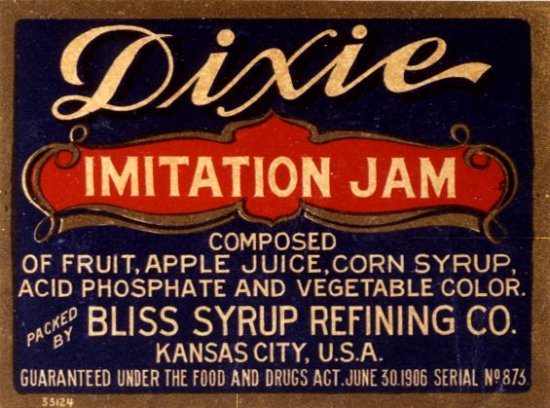
“You know how homemade jams and preserves taste. They are wholesome foods. When made from the pure juices of fruits and pure sugar they are expensive. On this account much jam sold at a low price is made from a brittle, glue-like substance called gelatine, to which acids are added, besides some unhealthful coloring matter to make them look like the pure jams made at home from currants, strawberries, grapes, and other fruits” (page 40).
Did you recognize these everyday foods? Corn syrup. Artificial colorings. Margarine. Baking Powder made with alum. Jelly.
Isn’t it amazing that these were once so demonized for being adulterated imitations of the real thing? In fact, in 1938 the widespread abuse of these foods caused the United States congress to actually pass the Food, Drug, and Cosmetic Act which required that the word “imitation” appear on any food that was an imitation.
This law was in effect until 1973 when the food industry finally succeeded in getting the law tossed out.
Perhaps you’re old enough to remember buying American cheese back when it was called “imitation cheese” instead of a “cheese food product.” Maybe you remember seeing margarine labeled as “imitation butter” or jelly labeled as “imitation jam.”
Not any more.
Now an entire array of fake food products fills our grocery stores. To quote Joel Salatin’s expression of pure poetry, most foods sold these days are “irradiated, amalgamated, prostituted, reconstituted, adulterated, modified, and artificially-flavored, extruded, bar-coded, un-pronounceable things.”
I want to return to an age when our dominate culture understands food the way it did a mere 100 years ago. And I share Salatin’s optimism when he says, “I do think that the world we currently live in is a veritable blip, an abnormality cyst, in the continuum of human history. Chances are in the distant if not near future our food system will be more decentralized, localized, and in-home prepared than it is right now. And that looks a lot more like the food system of 1800 than the one of 2009.”
May it be!
This post is participating in today’s Fight Back Fridays blog carnival, hosted right here at Food Renegade. If you want to check out other articles, stories, news, and recipes relating to Real Food, go check it out.
 |




Lessons on Real Food from 100 years ago. What an amazing difference between then and now! http://su.pr/1j8Ydr (via @FoodRenegade)
This comment was originally posted on Twitter
When I asked my mother about the foods her parents ate (she is 80 now) she talked about white flour and ‘butterine.’ She said more than one third of the meals she ate as a child were beans and white biscuits. I had to go back even further than that, to what her grandparents ate before finding any real food. These methods, foods and stories are being lost at a rate faster than we are rediscovering them. Thanks for posting this last-century wisdom before it was lost!
.-= Local Nourishment
Hi Local Nourishment. Just curious how is your mother’s health and current diet? Many people don’t seem to live up to 80 years these days! I wonder if she has gone to more natural foods.
Thank you RT @FoodRenegade: Lessons on Real Food from 100 years ago. What an amazing difference between then and now! http://su.pr/1j8Ydr
This comment was originally posted on Twitter
Reading @foodrenegade Lessons On Real Food From 100 Years Ago http://tinyurl.com/mtgvs5 What a find!
This comment was originally posted on Twitter
Real food, 100 years ago: http://bit.ly/iT9S3
This comment was originally posted on Twitter
Lessons On Real Food From 100 Years Ago | Food Renegade: It’s called Graded Lessons in Physiology and Hygien.. http://u.mavrev.com/021kb
This comment was originally posted on Twitter
Reading @foodrenegade Lessons On Real Food From 100 Years Ago http://tinyurl.com/mtgvs5
This comment was originally posted on Twitter
Lessons On Real Food From 100 Years Ago | Food Renegade: This law was in effect until 1973 when the food industr.. http://bit.ly/pQO2k
This comment was originally posted on Twitter
What I think is really sad is my grandparents generation. They are nearly 90, were dairy farmers who wouldn’t even think to *not* put their cows in the pasture. They drank fresh milk, ate steaks so many times my dad said “we used to come home and say ‘oh man, steak again!'”
Their generation was inundated with all of the new fangled garbage foods. My grandma can’t even look at dairy without getting sick anymore because of all of the low-fat pasteurization/homogenization that has done her in. She is convinced that she can not grow apples unless their is a chemical involved. They now rent their land out to monocroppers who probably get paid *not* to grow anything – they are in the land of corn and soy after all.
So sad, but because they had many years of real food they’ve been fairly health compared to my generation who was born into it in the ’80s.
.-= Shannon
If anyone is interested in reading the book above, Google library has it for download: http://books.google.com/books?id=KZhsieYZAsEC&oe=UTF-8
Thanks for the link!!
Thanks for the download link. I was just thinking, how can I get that book? The man’s intuition is amazing! Then again, he is looking at things from a different angle than most do today. His world is flip-flopped from ours. How I wish this was not the case. Like you, I say of Joel Salatin’s optimism – Let it be!
.-= Wardeh @ GNOWFGLINS
I don’t even know what to say. I get so emotional (angry) when I realize how aldulterated our food has become. It’s so frustrating. I’ve spend much time getting nourishing foods for my family but my heart breaks for those who don’t know about good, nourishing foods.
“This sugar is quite apt to ferment, or sour, and decay within the bowels, thus causing disease.”
Kristin, I have a question about the above quote. Fermenting sugar is bad but fermented foods and drinks are good. I know there is a difference but can you explain what it is, please?
Thanks!
My guess, Tina, is that it depends on where the fermenting occurs. The fermenting of food and drinks is done outside of the body and utilize people introducing particular strains of beneficial bacteria into the food or drink in a controlled environment.
The quote above about sugar fermenting/decaying within the bowels and causing disease is coming into a person and feeding the non-beneficial gut bacteria, which then leads to disease.
Which bacteria are being encouraged to proliferate and how…that is the difference as I’m seeing it. Hope that helps! 🙂
Great post– I’d love to get my hands on a copy of that book. I too plan to ask my grandparents (lifelong farmers) to impart their real food wisdom, and to teach me how to make preserves, can tomatoes, etc., while they still can! When they still had their apple orchard, the whole family used to gather to help make cider… it was so pure and delicious… nothing I’ve found since then even remotely compares. Even the cider sold at my local farmer’s market is now pasturized!
And as for the current legislation that is meant to “protect” us and keep our food supply safe, I wish we could go back to the (simpler and stricter) PFDA of 1906, which was a response to the atrocities uncovered by Teddy Roosevelt and Upton Sinclair. The contradictions and loopholes in the FFDCA of 1938 (and it’s subsequent amendments) range from troubling to downright alarming! What’s sad, though, is that food is the most closely regulated of the bunch. But because we have a reactionary government, stricter standards and safety measures are (usually) only approved after something tragic happens.
.-= ChicaGoinGreen
@jenshow A blog post I think you’ll enjoy on Real Food. http://bit.ly/iT9S3
This comment was originally posted on Twitter
ChicaGoinGreen — The worst thing about the new laws is that they’re intentionally designed to provide a lot of crushing oversight to the smallest (and safest!) producers, rather than the food behemoths.
Tina — Fermenting sugar creates alcohol, which destroys good gut bacteria & enzymes and causes bad bacteria to multiply. The fermenting of vegetables & dairy creates lots of beneficial bacteria & enzymes used to preserve the food & keep your digestion in good working order.
Shannon — I feel you pain. I know several people who grew up on old-fashioned dairy farms, eating & drinking the freshest foods imaginable. Then they were sold on industrial foods not only by convenience, but by the promises of modern science. They’re a generation of people with implicit trust in science — doctors, pharmaceutical companies, research laboratories, technology. Anything science declares can not be questioned, but must be whole heartedly embraced. Never mind that all these scientists are simply — like anyone in any industry — out to turn a profit, not necessarily look out for the best interests of individuals. Never mind that these scientists ONLY make money when you’re SICK, so they have a vested interest in keeping you that way! Never mind that science isn’t as objective as enlightenment idealists hoped it would be, and is as subjective as the people designing the experiments and interpreting the results. So, if science says margarine is safer, healthier, and more nourishing for you then butter, then by golly it is! Truly tragic.
@jenshow A blog post I think you’ll enjoy on Real Food. http://bit.ly/iT9S3 (via @jennstonel)
This comment was originally posted on Twitter
Lessons On Real Food From 100 Years Ago http://tr.im/wrnp
This comment was originally posted on Twitter
I have been doing my own research on this in Ottawa, Ontario Canada. I am trying to find books that have recipes of food from up to 1000 years ago. It is very rare to find a book like the one you did, impressive. I actually found one relating to the paleolithic age. It says people are pretty much the same as they were 10,000 years ago except for the way we eat and live. People didn’t die from cancer, diabetes or heart disease, they were eaten by tigers if they didn’t run fast enough. Our bodies were meant to move not just 20 minutes a day but almost all day long.
It sounds like a beautiful book! I tried to search for it at my library’s database as well as searching for it at Amazon.com, with no luck at either. Would you know how to obtain a copy of the title?
http://www.archive.org/details/gradedlessonsin03krohgoog
Can download for free or read online, a lot of libraries archive books now 🙂
Lessons On Real Food From 100 Years Ago http://bit.ly/iT9S3
This comment was originally posted on Twitter
Adulteration of food isn’t new. Some of the oldest laws in existence (pre-New World) are food purity laws, because after agriculture became widespread, specialization of labor and growth of urban populations often meant someone else was preparing food for the masses (& profit). Temptation to cut corners seems to be a long-standing human trait that requires regulation and inspection.
Another very good book to read from that era is the classic 1906 novel The Jungle by Upton Sinclair, which exposed the corruption of the US meat packing industry. There are still a lot of parallels to today, unfortunately.
Textbook warns against artificial ingredients, HFCS, Trans-Fat. Espouses whole natural foods. Published in… 1908. http://bit.ly/2OOpIF
This comment was originally posted on Twitter
Textbook warns against artificial ingredients, HFCS, Trans-Fat. Espouses whole natural foods. Published in… 1908. http://bit.ly/2OOpIF
This comment was originally posted on Twitter
HealthInfo:A cute article from Food Renegade #fightbackfriday, “Lessons On Real Food From 100 Years Ago”: http://bit.ly/2OOpIF
This comment was originally posted on Twitter
http://bit.ly/hJFXg
Reading Food Renegade – Lessons on Real Food from 100 yrs ago
This comment was originally posted on Twitter
Fascinating article, Kristen! I wouldn’t be surprised in the least to find that Michael Pollan is descended from Dr. Krohn.
.-= Ren
Weston Price’s work is another major example of how much common sense we’ve lost sight of over the years. His work was published in the 1930s and clearly hasn’t had the influence it should have. In my opinion, it shows the unfortunate reality of how powerful the influence from big industry is. I certainly hope Salatin is right and that it will happen soon enough for us to see it in our lifetime.
.-= Vin – NaturalBias
Lessons on real food from 100 years ago http://bit.ly/3NhycA by @foodrenegade
This comment was originally posted on Twitter
Lessons On Real Food From 100 Years Ago – http://tinyurl.com/mtgvs5
This comment was originally posted on Twitter
Reading @foodrenegade Lessons On Real Food From 100 Years Ago http://tinyurl.com/mtgvs5
This comment was originally posted on Twitter
100 yrs ago, docs had food adultration concerns! RT @vinmiller Lessons on real food from 100 years ago http://bit.ly/3NhycA by @foodrenegade
This comment was originally posted on Twitter
Lessons on real food from 100 years ago. http://ow.ly/knyQ
This comment was originally posted on Twitter
Reading @foodrenegade Lessons On Real Food From 100 Years Ago http://tinyurl.com/mtgvs5
This comment was originally posted on Twitter
Century-old, real food knowledge (Compare it to what has come to pass!): http://bit.ly/oLeht
This comment was originally posted on Twitter
Lunch: tomatoes I grew on bread I baked. NOT typical for those of us who eat “adulterated foods.” http://bit.ly/2OOpIF
This comment was originally posted on Twitter
Your book is a great find! When we had our first child, I did extensive research on nutrition and food to ensure we were the healthiest possible and feeding our children the best food possible. It’s amazing how so much vital information from generations past is ignored or lost. With many hours of research on the internet and talking with several people, we’re able to provide our kids the proper nutrition and best foods available. We can already see the benefits in our children’s behaviour, energy and intelligence.
.-= Ryan
Reading @foodrenegade Lessons On Real Food From 100 Years Ago http://tinyurl.com/mtgvs5
This comment was originally posted on Twitter
The @FoodRenegade writes “Lessons on real food from 100 years ago” http://u.nu/6u633
This comment was originally posted on Twitter
Sugar was once outlawed! Reading @FoodRenegade ’s “Lessons on real food from 100 years ago” http://u.nu/6u633
This comment was originally posted on Twitter
Thanks so much for this post. I have been researching this very subject for a while now. Everything from edible weeds to making my own sausages and cheese.
I am currently reading the Rodale series and Eliot Coleman on winter gardening. This is the type of info they should be teaching in schools!
What a wonderful post! I was so encouraged by this great knowledge of the past that I had to get a copy for myself! Found one on E-bay…written in 1900. The binding is rough but shows how hungry people once were for “real food” knowledge! Can’t wait to get my hand on it!
Do a google search, you can download many old books for free due to I think coming into public domain after a certain amount of years?
http://www.archive.org/details/gradedlessonsin03krohgoog
To download 🙂
I recently picked up a church cookbook from 1913. In it there is ad space sold to various businesses. But one entire page of ad space explains how dangerous baking powder with alum is and how it will not only ruin your health, it will make your baked goods less tasty.
How far we have come!
I collect very old cookbooks. I scan antique stores on a pretty regular basis. The best old cookbook I have, though, it not an old book. It is a collection of ideas and recepes that someone put together after they interviews 1000s of people that lived through the great depression in Oklahoma, Lousiana and Arknasas. I don’t have the book with me, or I’d tell you the title. I is SO interesting to read how people managed to survive the great drought during the economic depression.
Amazing! It’s so sad to think how far our culture has gone away from this wisdom… thanks for ending your post on a hopeful note – this subject always gets me bogged down!
So interesting!!
I’m “thumbing” through an online copy of this book, and I love this, on p. 225: “The individual who is physically sound and mentally sane is so chiefly because, in the rush and stress of modern life, he has not resorted to any artificial means, such as alcohol, to whip him on to success, or narcotic drugs to deaden the feelings of fatigue and allay nervous excitement. He has learned the joy of possessing a body strong in limb, rich in clean blood, steady in nerve, clear in brain, and needing no stimulant other than clean air, pure food, and invigorating sunshine.”
I love this!
My Grandmother(who is in her 80’s) was raised on real food! She grew up in Panama on a farm. They ate fresh meat from the butcher, and her mother always made sure to make liver at least once a week. They ate a verity of tropical fruits and lots of veggies and rice. They drank fresh milk, but they boiled it. A very simple diet, but all whole foods!
I can only hope that Joel Salatin is right! We need to continue to educate, educate, educate.
Thankfully my mom and grandmothers cooked from scratch, so I had their experience to draw from when I was growing up, but so many of my friends had no real cooking mentors. I have to admit that it’s pretty cool to be able to help people out through the internet – kind of makes me feel like I have an extended family.
Love the book find and quotes. I am also thrilled that I can read the book myself online (thanks to your lovely readers sharing). How much has been lost that needs to be found again. Goodness!
Had to share a few quotes and your post on my blog today. I grew up on margarine… ewww, gross!
The Dr’s last name is spelled Krohn, which is helpful to have the correct spelling when looking in the public domain for his books. 🙂
nice i like this one
Great article! Thank you for reminding me of what used to be on packages. I had forgotten all about that. I never understood why my parents bought margarine instead of real butter.
I found the book on Amazon for about $32 NEW Hardcover.
Great! I found a cook book from the 40s that instructs on how to clarify all kinds of animal fats, and discusses vitamins F and G.. So interesting and useful!
This actually made me tear up a little. How amazing and yet incredibly devastating at the same time!
I bet he’s turning over in his grave…
Am I the only one who has problems with Food Renegade’s website? Every time I pull up a link, it has ads on it that immediately begin playing and they lock up my pc. I hardly ever open the links anymore, but just tried again. No bueno. It’s the only site I have a problem with.
Good book and good find!
This fire’s been burning for a l-o-n-g time. Disheartening. (This book would make for a good re-printing, perhaps.)
What great knowledge he had back then. We need him or someone like him today for me that someone is you. I love reading and learning just how messed up our food is now from our great FDA. Thank you for all your work and taken the time to start making us aware of what we are putting in our bodies. A big THANK YOU.
I got a box strawberry cake mix last week, its probably best if I don’t disclose the brand here. I mixed it and put it in the oven. Not too long later, a weird smell was taking over my apartment. I followed the odor to my oven, the baking cake did not have that fresh, natural, sweet smell that a good cake baking always had. Remembering my childhood with my mom and grandmother baking cakes how good they smelled, and tasted. Back in the old days, food was made so fresh and natural, so wholesome. Now in the 21st century we are in an age where so many foods have so many chemicals, additives, and fillers added to the ingredients, including cake mixes. That weird smell of that cake baking was another typical 21st century chemical filler smell, quite a change from the sweet fresh baking cake smells people knew back in the 1930s, 1940s, and 1950s.
I especially liked the ad for country crock plant based butter at the end of the article.