
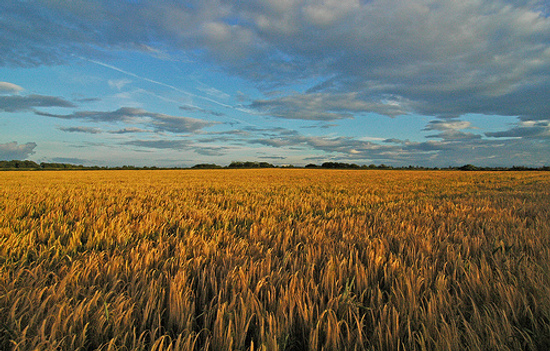
If you had to name the largest single threat to the environment that you could think of, what would it be? Climate change? Global warming? Deforestation? Overpopulation? Wars? Pollution? A Global Pandemic?
My answer is easy: The single greatest threat to Earth as we know it is the presence of genetically modified organisms (GMOs) in our food supply. Decimate our food supply, and the rest won’t matter.
But are GMOs really that dangerous?
YES!
And here’s why. GMO crops cross-contaminate. That means that non-GMO corn planted in a field next to genetically engineered (GE) corn will take on the GE characteristics in its next generation.
So if there’s anything —anything — remotely unsafe or undesirable about a GMO crop (like it’s lack of promised yield, for example), it can spread like wildfire through our food supply.
But aren’t GMO crops safe?
After all, if they weren’t safe, they wouldn’t be FDA approved, right? After this year’s peanut debacle, that question is almost laughable. But here’s an answer for you: There has been almost no testing done on the safety of GMOs — none.
They were passed through the FDA by giant agribusiness lobbyists arguing that GMOs aren’t substantially different from their non-GMO counterparts. In other words, it was just an argument. Just words. There weren’t actual clinical trials done on the safety of GMOs.
And the few trials that have been done have shown alarming results — allergies, increased cancer risks, damaged food quality. Many GMOs are created using antibiotic resistant genes, and the British Medical Association cited this as one reason why GMOs should be banned worldwide due to the threat they posed for the future efficacy of antibiotics.
But wait! It get’s worse.
Here in the U.S., GMOs aren’t required to be labeled.
That means that even if you had an allergic reaction to a GMO, you’d have no way of knowing that the GMO crop caused it. In other words, the public health effects of GMOs are currently untraceable.
It also means that GMOs are in just about everything Americans consume (more than 75% of the food in the average supermarket contains GMOs).
Numerous polls have shown that 9 out of 10 Americans want GMO foods to be labeled, but giant biotech corporations are vehemently opposed to the idea.
Why?
Because they know that if they were forced to be labeled (as they were in Europe), consumers would stop buying them. Right now, they’re all pervasive and most people don’t even know they’re eating GMOs. If they saw the GMO ingredients in their tortillas, their cookies, their infant formula, they’d think twice about buying them.
Celebrate Earth Day by joining the No-GMO Challenge!
Today Real Food Media and the Institute for Responsible Technology are launching the No-GMO Challenge. It’s a rolling challenge, which means you can join at any time.
Our goal? To put pressure on food corporations to stop using GMOs in their foods. We believe that if just 5% of the U.S. population consciously started avoiding GMOs, they could be purged from our food supply.
That’s an amazing feat, but it’s totally doable!
The No-GMO challenge will feature contests & prizes, a weekly blog carnival so that bloggers can write about the dangers of GMOs with a united voice, and more!
(photo by jimmedia)
 |




Excellent post – there is some labeling help though – For conventionally grown fruit, (grown with chemicals inputs), the PLU code on the sticker consists of four numbers. Organically grown fruit has a five-numeral PLU prefaced by the number 9. Genetically engineered (GM) fruit has a five-numeral PLU prefaced by the number 8. For example,
A conventionally grown banana would be: 4011
An organic banana would be: 94011
A genetically engineered (GE or GMO) banana would be: 84011
Unfortunately, where ingredients are concerned, consumers are pretty much in the dark. We are definitely joining the no GMO challenge!
Magge Mae Farm
I’m aware of that, but I’ve seen PLU codes in some of the small produce stores that had three number codes; which to my knowledge, don’t even exist! I don’t trust any “Organic” food from Canada (or the U.S., for that matter) that contains canola; as 100% of Canadian canola is GMO and I’m sure it’s the same in the states…very difficult to know what to trust. I’ve got peanut butter that claims to be organic, but I’m sure it’s not. The consistency is just too soft for “just peanuts” – even ‘cold’ in the fridge!
Maggie Mae — Yes, while that’s helpful for those who know what they’re looking for, it still doesn’t help the average person at the supermarket make educated choices. How are they to know the magic numbers to avoid on a PLU? Seriously! It’s just too much to ask. And, like you wrote, it’s not helpful at all for reading ingredients labels.
Glad you’re joining the challenge. Please do your best to let others know about it, too. Email it to friends and family. Share it on Facebook or MySpace. Tweet about it on Twitter. Digg it. Stumble it. You name it. If there’s a way for you to share this that you use, please do!
For those wondering what all the hub-bub is about, I strongly suggest listening to one of the top world crusaders against genetically engineered food: Dr. Vandana Shiva ( http://www.navdanya.org ). She was in Portland, OR, recently and took the time for us to film an interview.
In part 1 of “Vandana Shiva: The Future of Food”, she lays out her deep concerns about genetically engineered food – http://bit.ly/XkmC7
In part 2, she talks of hunger, farming, and more about biotechnology –
http://bit.ly/18ACjt
In Part 3 she also shares the growing awareness & her hopes, which will be posted this Friday, on the Cooking Up a Story website. Please feel free to share. She has an important message to be shared for all of us.
Thanks, Rebecca
Rebecca/CUpS
She’s very good. I like her. 😉 I wish she’d come to the University of BC to talk. Most of the students were recently bombarded with “free” samples of Stride gum – with three arificial sweeteners…like sheep being led to the slaughter!
Rebecca — Thanks for linking to those videos here! I’m planning on sharing them & commenting on them in posts over the course of the next month of the challenge.
Here’s my thought about GMO foods – if you eat, as much as possible, all organic or locally grown foods, and avoid processed and packaged foods, you are doing the very best you can to keep away from genetically-modified items. However, I have heard much talk about the dangers of GMO seeds and that they can blow over into non-GMO crops and cross-pollinate. Now, this is something that is even scarier than the original GMO terror itself – because basically when cross-pollination starts, it doesn’t matter if any of us choose to eat so-called non-GMO and organic foods. We’ll get GMO anyway because everything will be cross-pollinated!
Raine Saunders
You’re exactly right! Many businesses selling garden plants and seeds aren’t even aware that many of them are GMO. I had a couple of plants (veggies), bought from a local garden store, that I could tell were GMO. They were terrible!
Listen, I just joined the UK Bloggers Association and I spontaneously uploaded the I am a Food Renegade logo as my pic.
I love it better than my own mugshot!
http://ukfoodbloggersassociation.ning.com/profile/ElisabethWinkler
Elisabeth
Scary stuff. It boggles my mind that this is real. I am going to tweet the heck out this!
Elisabeth — What fun! I love that logo, too. I don’t mind if it gets spread around. The more self-proclaimed Food Renegades the better!
Michelle — THANK YOU! We really need to do everything we can to spread the word!
Hello Food Renegades!
Here’s a link from The Progressive (2001) which gives stats and the story of the fight to save GMO-free crops: http://www.progressive.org/0901/lil0901.html
Basically, organic standards require growers to incorporate practices such as buffer strips and later planting dates (especially for soybeans, corn, cotton, and canola) which help to discourage cross-contamination, Yet, it’s becoming more and more difficult and costly to regulate. Legislation often penalizes the farmer instead of the seed company. 🙁
I am so glad you are happy for me to use the I am a Food Renegade icon as my avatar – I love it too!
Elisabeth
Monks did it. Although I do NOT eat grains to begin with- I don’t see the danger as you folks do, although I do fear for my food supply also
sorry I see the danger now.
I can’t believe it has been only a few years (well 15 or so) since the GMO’s starte emerging heavily. I remember back in 8 grade biology we had those discussions about them. And now we actually are experiencing the consequences…
Here’s to a brighter future without GMOs!
Yavor
.-= Yavor´s last blog post …Mark McManus Interview, The Muscle Hacker Shares His Wisdom On Building Muscle And Carving Out A Six Pack =-.
I’ve been learning about GMO food recently. I used to brush off criticisms of them because my Dad always said they helped feed the world. I’m learning otherwise. Thanks for the good info. Keep it up.
.-= Caveman Sam´s last blog post …Candied Nuts =-.
GMO’s are awful. I’ve seen a couple documentaries and read some stuff about it. I have no doubt that GMO’s are bad. I can’t afford to eat organic though!! That’s another awful thing so therefore I will be growing my own food this coming season if I can.
GMO’s and Monsanto and friends make me furious. Our government and agencies allow this to go on because they are all paid off. I don’t think any kind of boycotting will help; because they’ll just have all the labels removed so we don’t know what we’re eating (check out what Codex Alimentarius is up to)! That being said; I stay away from any known GMO; EX: soy, corn, canola, cottonseed. The thing is, these corporations have so many tricks to disguise their products and such, it’s tough for even the most astute shopper. I think a 6 year old could read a few articles on GMO’s and determine that they are evil. I’ve noticed that in Canada, now, cottonseed is in everything. It wasn’t so a year ago. The Easter candy is full of it. This gets worse by the day and 99% of the population are still oblivious and evidently, most of them want to stay that way.
pjnoir is soooo wrong. Although any grain consumption is counterproductive- GMO’s are destorying the food chain. Monsanto is no different than a war criminal
What happened to the link to the non-GMO challenge on the RFM website? And why can’t I find contact info on the Real Food Media website to ask them directly?
Hi Kris,
The site underwent a major re-design/overhaul a while back, and I think the Non-GMO Challenge portion of it was not put back up when the site went live again. Even now, the site’s still in the middle of being tweaked.
i don’t see where i can download the non-gmo shopping guide or sign up for the challenge. the link sends me to the ‘about’ page with info on advertising on your website. i searched around a few other tabs and still not seeing it..
That’s because the non-GMO challenge talked about in this post took place more than three years ago! Since then, the Real Food Media site has undergone some major overhauls, and the Non-GMO Challenge part of it was taken down. For more info, I suggest going to the Non-GMO Project that the challenge helped launch: http://www.nongmoproject.org/
I’m very interested in joining the no-GMO blog challenge. My blog is all about No-GMOs. My blog features recipes that contain organic or non-gmo ingredients. Each link I’ve clicked on from your post above, and on two other blogs (one being Cheeseslave’s) bring me to a page that “Isn’t found”… Any advice on how to be a part of this?
Thank you!
Hi Kristine,
Please see my comment to Jennifer M, above!
Thanks,
~Kristen