
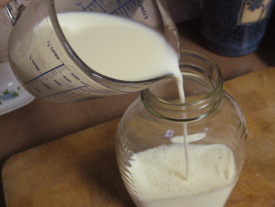
Make Your Own Buttermilk
There are a lot of reasons to learn how to make buttermilk.
Fluffy whole wheat pancakes. Grandma’s flaky biscuits. Ranch dressing.
Need I say more?
This hero of cultured dairy products makes grains more digestible, salads more tempting, and white sauces more tasty.
It’s a shame that it’s darn near impossible to buy.
A trip into the dairy section of just about any local grocery store will leave the real food lover disappointed. Most buttermilk is fake!
Take a look at this store-bought buttermilk label and see if you can’t spot what’s wrong:
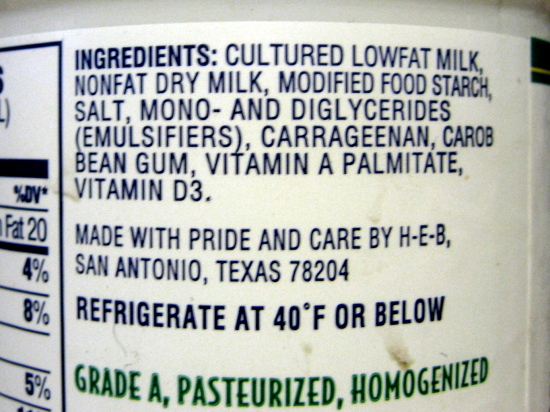
What's wrong with this picture?
Or, better yet, answer this — what’s right about it?
If you want good, old-fashioned cultured buttermilk, you’ve either got to go to a health food store or make it yourself.
So, here’s how you can do it.
First, the EASY way.
The Players
- 1 cup of cultured buttermilk
- 3 cups of whole milk
- 1 lidded glass jar
The How-To
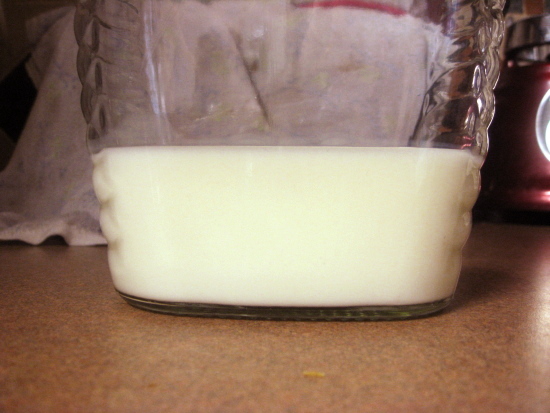
Pour the buttermilk into the jar.
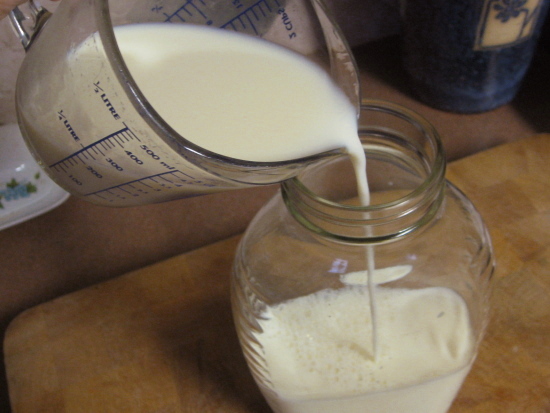
Add the milk.
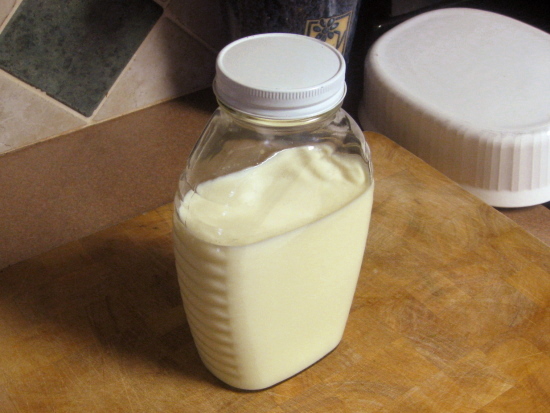
Shake it up, then let it sit on your counter or another relatively warm place for 24 hours. When cultured, the thickened new batch of buttermilk will coat your glass. Now, pop it in the fridge, and it will last for weeks. Easy!
Please Note:
1) Quantities don’t matter as much as proportion. Stick to the 1 to 3 ratio, and your buttermilk will always turn out well (as long as your starting culture is alive) whether you’re making 1 cup, 4 cups, or a gallon.
2) If you use raw or non-homogenized milk, your cream is likely to separate and culture on its own as well. That layer of cultured cream is creme fraiche (European sour cream). Enjoy!
Next, the (slightly) harder way, which involves making your own buttermilk culture from raw milk.
- Allow a cup of filtered fresh raw milk to sit covered at room temperature until it has clabbered (usually several days).
- Place 1/4 cup of the clabbered milk in a pint mason jar, add a cupof fresh milk (does not have to be raw at this point), cover, shake to mix, allow to sit at room temperature until clabbered.
- Repeat this transfer of sub-culturing several more times until the milk dependably clabbers in 24 hours. Taste a small amount to confirm that it is tart, thickened, and has no off flavors. It should taste tart not bitter, for instance.
- To then make a quart of buttermilk with this culture, add 6 ounces of the buttermilk to a quart jar, fill with fresh milk, cover, shake to mix, allow to sit at room temperature until clabbered.
- Refrigerate.
If you’re looking for a good starter culture for Buttermilk (or any other fermented foods like Kombucha, sourdough, yogurt, etc.), check out the listings on my resources page.
 |




It’s crazy the junk they mix in with such a simple food. Real buttermilk is phenomenal for cooking and baking. It lends this very, very soft crumb to whole or sprouted grain baked goods. It’s an integral part of our kitchen. Good post.
Jenny
I was actually inspired by your “Name That Food” series of posts. I mean, seriously, if I had posted the ingredients on that label, would *anyone* have realized it was buttermilk?
Thanks for that! Quick question: will it hurt if I use storebought buttermilk for my initial batch? I can’t get anything else around here, and I figure the amount of crap will diminish as I make more batches.
Hi Semi Crunchy!
Thanks for posting.
If you have to use store-bought, then at least try to find some without Modified Food Starch in it. But, if it is your only option, I say go for it! Making your own will still be more wholesome than buying the crap. And, you’re right, the bad stuff will diminish as you make more batches.
This recipe is awesome! But I have a question, can I use the leftover buttermilk from the butter making process for this easy method recipe? Because I don’t know if my leftover buttermilk is considered cultured.
Ah, HEB. I once wrote to them on their website about the partially-hydrogenated fats in their flour tortillas. Not a word back from them. Too bad they’re practically a monopoly in San Antonio!
HEB isn’t all bad. Ours has a reasonable bulk foods section, and anytime I’ve asked a department head for something special (uncured bacon or sausage, grass-fed beef, rennet, you name it), they’ve generally started stocking it. That said, MOST of the so-called food in that store is just like any other grocery store — fake!
I’ll have to use method #1 because, in Canada, acquiring raw milk is a near impossible endeavour due to the eagerness to prosecute the suppliers (it is illegal to sell raw milk). Geez…the law is easier on marijuana possession.
Just a note – ask around and find out if any of your local organic dairy farmers offer a herd share program. With these, you pay a fee to buy a share in a milking animal (goat or cow) and then you pay a weekly fee to the farmer for caring for and milking your animal. You’re not buying the milk because, as a part-owner of the animal, you’re legally allowed to drink it.
The government is screaming about it, and saying it’s just a way to get around the fresh milk laws (of course it is!), but the Ontario courts have declared that it’s legal, and herd shares are reportedly springing up everywhere.
The difficulty in finding a herd share is that the farmers are not allowed to advertise in any way, so it’s word of mouth. I started making friends with some Mennonite farmers and eventually got a recommendation.
The fresh milk is wonderful stuff at all stages and in all forms, from sweet right through to soured, and it’s well worth looking for a herd share.
hi are you sure about the cow share? i have miniature dexters that i milk and i always have two much ,was wondering what to do with the extra, i live out side davidson,saskatchewan how would i fine out if this is legal? thanks
Even in big towns you can buy raw milk for animals…..it is labeled “Raw Milk for animal consumption” …… Perhaps your animal will share with you……lol
We have the same problem with it being illegal so we just give it away. Then we get goodies in exchange 😉
I know where you can get raw milk in Canada depending where you live. Contact me if you are interested.
Can you swap something for raw milk and protect the dairy farmer?
I grew up in CAnada. Things have sure changed.
This is a great and really informative post. Thank you so much!
HoneyB
Fluffy — That’s a bum deal!
Honey B — Thanks for the kudos. 🙂
hmmm…..very useful… i will surely try this .. i found a buttermilk marinated chicken recipe once… now i can do it with my own homemade buttermilk..
lovely!
mizdi
*comes out of lurkom*
Love your blog, but i have a question on this post. I have some….really old raw buttermilk in my fridge from last year’s thanksgiving that I haven’t used. Can I use that to make some fresh buttermilk?
Thanks!
Tamara,
Thanks for your comment! To answer your question, I don’t think it will work as well. If your buttermilk’s that old, the live cultures in it are probably mostly dead. It may still be totally safe to consume and use, but it probably won’t be strong enough to help start a new culture.
If you really want to use it, perhaps you could try using it along the lines of method #2, which concentrates relatively weak cultures until they’re strong enough to clabber the milk within 24 hours.
As always, it’s your call. 🙂
Cheers,
KristenM
I’ve been lurking for a while, and now I have a reason to comment!
So I wasn’t even looking for buttermilk today, but I remembered this post when I was at the grocery store. I was in the baking aisle, and came across a product called Saco Cultured Buttermilk Blend for Cooking and Baking. (Say that 3 times fast!) Basically, it’s powdered buttermilk. I was skeptical, but I checked the ingredients:
A cultured blend of sweet cream churned buttermilk, sweet dairy whey, and lactic acid.
I went ahead and picked some up, because the price wasn’t bad, and I love using buttermilk, but it always goes bad on us before we use it all, and to me, this is easier than making your own. It actually requires refrigeration after opening, but says it’s good until October 2012. I don’t know if that date is before or after opening, but I’m guessing it should last a while.
Thoughts?
April — Thanks for your comment!
You may not like what I’m going to say, but I would avoid it for the same reasons I’d avoid powdered milk. First, the drying process pasteurizes and completely kills any of the benefits of the buttermilk culture (enzymes, probiotics, etc.). It’s also likely to create free glutamates (another name for MSG).
You’d be substituting a living, health-promoting food for a dead, harmful food.
In my book, it’s just not worth it.
Hmm…I should look into the milk-drying process and learn more about that. I am fairly new to the world of real food, and trying to make the best choices I can, but there’s a lot to learn!
Here’s some information from their website:
http://www.sacofoods.com/culteredbuttermilkblend2.html
If what they’re saying is correct, which would be the lesser of two evils in your opinion–the Saco powder, or the conventional liquid buttermilk found at most stores? Like I said, I went ahead and picked some up, and I just used it for the first time (I have some muffins getting ready to go into the oven). I’m going to do some more research, and see how it goes. If nothing else, I may be able to use it to start my own buttermilk culture.
Thanks for the input! I’ve really been enjoying your blog!
April — SACO’s website is highlighting the difference between old-fashioned and cultured buttermilk. Old-fashioned buttermilk is what I get when I make butter. It’s thin, tart and acidic and good for soaking grains. Cultured buttermilk is what most recipes call for — particularly recipes that call for buttermilk in bechamel sauces and dressings. It’s also tart and acidic, but thick. SACO is wrong in implying that this cultured buttermilk not a traditional food. It is! Culturing milk in all its forms is as old as milking cows & goats.
Because the SACO buttermilk is dried, it contains no live cultures and will not be a good buttermilk starter culture.
Choose between two evils? I’d say don’t use either, unless you’re addicted to buttermilk baked goods or ranch dressing. Or, I’d say buy some good culture online (a lot of cheese-making suppliers will sell the stuff), then use that to start your own batch of buttermilk.
KristenM
Nice post Kristen,
I’ve been a label reader for over 30 years, but never thought to look at the buttermilk label. This junk will no longer be in my kitchen, and I’ll be making my own very soon.
Thanks!
Rod Newbound, RN
Labels are so scary, really! I love the simple directions, in the beginning of the post. I think that is how our grandparents cooked, you adapt for the ingredients that you have or have not. Culinary experts they were!
Heidi / Savory Tv
Ok – so I looked at the label again and again. True that there is a lot of stuff in there that doesn’t belong there, but I still have to ask: What (apart from that) is wrong with it? It seems to me that this label actually indicates, that the product is simply low-fat milk thickened with starch. Not buttermilk at all. Am I right? (Please comment!)
On another note…
I was born in Germany and buttermilk was (and is) a standard drink at home. If I try to introduce that to people here in the US, they think that I’m totally crazy and should have my taste- buds looked after. I’m not kidding! – Finally I convinced my wife at least to try it: buttermilk and orange juice 1:1. It’s so refreshing and delicious. Now sh loves it!
Thank you for your post!
I love buttermilk also. I found a place in Michigan that sells it, Calder Dairy in Monroe. They ship it around lower Miohigan. It is real buttermilk. My kids think I’m crazy, but it is so smooth, and I don’t think it is sour at all. I am going to try an make my own.
Dante — It’s not just that there’s stuff there that doesn’t belong. It’s the KIND of wrong stuff that is worrisome. Let’s start with the first ingredient: cultured low fat milk. Why low fat? From the get-go, this isn’t a whole food made from real milk. Then the next ingredients: non-fat dry milk and modified food starch. They add this to make it creamer, but both are known harbingers of processed free glutamic acids (AKA: MSG — Did you know MSG can go by more than 40 different names in the US and only one is legally obligated to be called MSG on product labels?). And that’s just the first three ingredients.
To be real buttermilk, the label should just say “cultured milk.” The end.
Now I will have to try buttermilk orange juice! It’d be great to find yet another use for this delicious cultured dairy product.
I think the “low fat” part makes perfect sense, in this instance. Since true buttermilk is the leftovers from butter making, (cultured or not – that’s an entirely different conversation), the original result is indeed, low fat, since most of the milk fat has been converted to the continuous phase in the process: i.e. the butter!
As far as the other stuff goes… yeah… no.
In the US where can I find raw milk?
Hi Steven —
Check out http://www.realmilk.com and search by your state for local farms selling raw milk. Even if the farm is quite a distance away (say 100 miles), you might find it’s worth calling them to find out about any drive-shares in your area (a group of people from your area that sends a designated driver to the farm once a week or once every couple of weeks to pick up everybody’s order en masse). In many states, raw milk farmers can deliver to your door or to convenient co-op or buying club drop points. In other states, you may be required to pick it up at the farm. Anyhow, that site is full of info!
Good luck!
KristenM
I have been making my own butter for a few weeks since joining a raw milk share coop, but I didn’t realize there were two kinds of buttermilk. Can I use the buttermilk from my butter to make cultured buttermilk? Can I use it interchangeably in recipes? How about to make creme freiche to make cultured butter? I’ve been putting a Tbs of buttermilk (from the butter) in a pint of cream and leaving it on the counter for 20-24 hours before I whip it up into butter. I didn’t think it was getting thick enough! Help!
Katie
Katie — Yes, you can. And, yes and no. You can sub between them, but just be aware of the type of recipe and how the subbing is likely to affect things. The difference will be in the creaminess/thickness level. Old-fashioned buttermilk (what’s left over after making butter) is very low-fat, so the cultured buttermilk you’d make from it will be far less thick. As to making butter out of creme fraiche or sour cream — go for it! I think it’s far tastier than sweet cream butter. If your creme fraiche isn’t turning out thick, it means your enzyme activity in your buttermilk starter is too low. Try increasing it using the same method you use to build up enzyme activity in the “slightly-harder” recipe above. When it clabbers to the desired consistency in 24 hours, then you’ve done it right!
One day I will try this… I swear.
You mention laking ranch dressing with homemade buttermilk, would you share a recipe for that?
I went to my wild by nature health store and the only buttermilk i could find at all was organic valley cultured lowfat buttermilk. Is it possible to use that to make buttermilk? i also bought a small unhomogenized milk from ronybrook farms, but it doesnt say if its pastaureized, but i suspect it is. I’m in new york on long island and have trouble finding anything raw….
Brandon — I am perfecting my recipe even now. One day soon, I promise I will share it!
Jessica — Organic Valley cultured buttermilk will do fine. It’s a heckuvalot better than the other stuff you can buy at the store! It’s great that you can find unhomogenized milk. Even if it’s not raw, unhomogenized is second best, particularly if it comes from grass-fed cows!
How long can you keep homemade buttermilk until you use what’s left to make more? A week? A month?
It may not be ideal, but my store bought buttermilk ingredient list says “Cultured Reduced Fat Milk and Salt”. It is pasteurized as well. I do have a source for raw milk, but I want my 14 month old son to be able to drink what I am able to purchase. In the interest of saving the raw milk required to concentrate the cultures, I’m thinking of using the store bought buttermilk to start a raw milk culture. Like SemiCrunchyMom, I hope the bad stuff will diminish with each new batch using raw milk. What do you think?
BTW, I recently found your blog, and I love it!
As in Canada, here in Australia the sale of raw and non-homogenised milk is illegal. Supermarkets don’t sell any kind of buttermilk. Will pasteurised milk make proper buttermilk? A lot of people seem to use milk soured with vinegar or lemon juice as buttermilk. Does this have the same nutritional and chemical properties as a cultured buttermilk? Can you use it to make your own buttermilk? Finally, is goat’s milk as good as cow’s milk for making buttermilk?
Elinor Entity — Pastuerized milk WILL make proper buttermilk. Just follow the first recipe rather than the second. As for the buttermilk substitutes, they work for FLAVOR, but not for the nutritional benefit. (They’re not probiotics.) I’ve never had goat’s milk buttermilk, but I don’t see why you couldn’t try it!
Help! I got a buttermilk starter from a friend who makes it with unhomogenized, but pasteurized milk, and I made a batch with raw milk, then a batch with store milk, then raw milk. That batch went bad – I mean smell invading my nose bad – in a week. ?? I thought cultured products were supposed to last longer? Any trouble-shooting for what I might have done wrong? Thank you!!!
Katie @ Kitchen Stewardship
What does he mean by “filtered” raw milk? I have access to whole raw milk. What do I need to do?
When you milk the cow, goat or whatever, it should be strained with a strainer pad, or other filitering system before use.
Kristen,
We buy raw milk all the time. I want to try the raw recipe, but I have always been careful with it because of what else can be found in the raw milk. We count on the refrigeration keeping the bad bacteria at a minimum. We also know that the milk is tested all the time. Everything I would use buttermilk for, grains, breads etc would be cooked so I’m not worried about using the raw buttermilk for those. My family loves ranch dressing and it is always better make with buttermilk. Is there any way to ensure that we don’t have an explosion of bad bacteria? Can it be pasteurized after culturing just for the ranch dressing? My wife is a real stickler on the milk.
Thanks for your post, it will come in handy as we strive to make the dollar stretch at our house by learning how to make things the way they should be made.
May I recommed reading “The Untold Story of Milk” by Ron Schmidt? Independent research shows that the good bacteria in raw milk are able to kill off any bad bacteria present. Pasteurizing kills all of the good, but not all of the bad, so the bad can proliferate. Raw milk is actually very safe, we just have to get past what we’ve always been taught. The book was very helpful for me.
.-= Kelly Cook´s last blog post …HenPals Nesting Boxes =-.
Drinking pasteurized milk and eating the by products comes under the heading of Garbage in Garbage out. ‘The Powers That Be’ have bad mouthed and propagandized Raw Milk for so long most people accept the slander as truth when all are lies. Fresh from the cow, raw milk has built in anti bacteria and germ destroyers. There are no proven cases of illness from drinking raw milk. All cases of illness when the ‘Powers That Be’ bother to check have been Pasteurized milk. The USDA, FDA, and CDC are quick to blame raw milk and make big news attacking raw milk. Then shut up when pasteurized milk is found to be the culprit. I am country and grew up drinking raw milk. Raw milk is a miss misnomer, for milk from a cow is a complete ‘Health’ food right from the source. In my 80 years drinking ‘healthy’ milk, I have never been sick from it, nor have known anybody who has. As for getting real milk or cream to sour, just set a jar on the counter covered with a cloth and it will sour naturally in 24 to 36 hours. Try that with pasteurized milk and it will just rot and stink. All this and more is on the internet. Check it out
Sean — You could pasteurize the milk BEFORE culturing it, the way you would do so for making yogurt. But I wouldn’t do it afterward, as that would negate all the benefits of it being a cultured, probiotic food.
I haven’t had buttermilk since I left Los Angeles 35 years ago. I still miss it. Some recipes tell me to put a teaspoon of vinegar or lemon juice into milk. Others say, use raw milk which I cannot buy. Here in Japan, milk is sold in various thicknesses. From skim to low fat to 3.2 to 4.4 % fat. I’m not sure which to choose. Also, can I use yogurt to start off the bacteria in buttermilk? Any help will do. Jack
Jack — You can purchase a buttermilk starter online. Click on my Resources page for listings.
What all do you do with the buttermilk left after making butter? I’m thinking about making cultured buttermilk but it feels so weird to do that when I have the buttermilk left over from the butter in the fridge just sitting there. We use only raw milk in our house if that makes a difference in your answer.
Also, I trying to find a good resource for how to use my raw milk. I want to make things like whipped cream, half and half, etc. If you have a blog or website that has great basics for using raw milk to it’s full potential that would be wonderful!
Thanks for the advise!
.-= Mrs. Not the Jet Set
Culture the milk, THEN make the butter. THAT is good stuff.
The original system was this – save the cream from several days milking (to have enough to bother with the effort of making butter.) As the cream was waiting, it would be naturally cultured. “Sweet” butter refers, specifically, to butter made with fresh cream, rather than cultured cream. But cultured butter was the more common product for a very long time.
Hi Mrs. Not The Jet Set — You can use the buttermilk remaining after making butter to make the cultured buttermilk. That’s what people originally did. You’d just add the buttermilk culture to it and follow instructions. It will be a little less thick, but just as useful and tasty in salad dressings & other recipes.
If you want to use raw milk to make whipped cream, half and half, etc., you’ll need to separate the cream from the milk. I’ve got a post that tells you how to do that on this site. Once you’ve got the cream, you can use it the way you would heavy whipping cream from the store: whip it to make whipped cream, whip it even more to make butter, add milk to it to turn it into half and half (but why not just use full fat cream? YUM).
Hope that helps!
~KristenM
(AKA FoodRenegade)
Thanks for the info! that was very helpful.
.-= Mrs. Not the Jet Set
I forgot where I read it but one of the Weston A. Price folks pointed out that nonfat milk solids are full of oxidized cholesterol! The bad kind of cholesterol. Yes, one more reason to make one’s own butter milk! Thanks for this 🙂
.-= Lisa Sargese´s last blog ..better to struggle =-.
Hi
I live in Canada and the buttermilk I have in my fridge right now is from a mainstream big industrial company, so it is certainly pasterized. But, I am wondering about the ingriedients. The only ingriedients it lists are: Milk, Salt, Bacteria Culture.
Is this closer to “real” buttermilk, or still not as good because of the assumed processing? Not to mention the unhealthly cows the milk probably comes from.
Can anybody elaborate on the below step to make your own B-Milk culture. I am not sure how to “repeat the process”. Do you add more of the clabbered milk to the pint? Any help would be great.
# Repeat this transfer of sub-culturing several more times until the milk dependably clabbers in 24 hours. Taste a small amount to confirm that it is tart, thickened, and has no off flavors. It should taste tart not bitter, for instance.
Darrell,
I’m pretty sure by saying “repeat the process” she means that each time your milk clabbers, you take 1/4 cup of that clabbered milk, and add a fresh cup of milk (in a new jar). You do this over and over, until it only takes 24 hours to clabber. Then you have buttermilk. Basically you’re building the culture up so that it clabbers in one day, instead of several days.
I’ve been making old-fashioned buttermilk (along with my butter) and I leave it sit out on the counter to “culture”. Sometimes I don’t get to it for days and by then it gets quite thick. Is it okay to leave it out that long? Is there something I should look for in case it goes bad? Once it looked like the butterfat (some falls in when I separate them) was turning a slight shade of orange, not a bad drastic color change, and there was no “off” order. I scooped it off (it was only on the top) just in case, but is this a bad sign?
I’ve done this twice now and we love it! I ran out of raw milk and really needed the rest of my buttermilk, so I used it all up, and hoped I’d have as much luckwith my 2nd try and making buttermilk. and I was! Thanks so much. I’ve passed this on to a number of people and they have loved it as well.
I keep mine in a half gallon glass jar, and when it gets down to one cup, I just fill it back up with raw milk, shake it up and let it sit out for a day until it’s nice and thick. It’s so easy to manage, and makes baking and marinating meat so easy and yummy!
Someday I hope to get us all to drink it straight up-but we’re not ready for that quite yet. 🙂
Thanks again!!
Sarah
.-= Sarah´s last blog post …Tuesday Twister in My Kitchen =-.
I’m very happy to have found your website. Please tell me, the second recipe is Cultured Buttermilk? Not regular buttermilk? I really need to make some Cultured Buttermilk and have found myself confused on that matter.
Thanks,
Jenn
.-= Jennifer´s last blog post …A Fresh Start =-.
Yes, Jennifer. The second recipe is for Cultured Buttermilk.
2 Questions….on making your own Buttermilk cultured from raw milk, the first step is to let a cup of raw milk sit for a day. Then you take a 1/4 of that cup(after it has clabbered) and put it in a pint mason jar. My question is..what do you do w/ the left over 3/4 of the clabbered milk? Throw it away?? (I also have no idea what Clabbered milk looks like).
My second question is in reference to step 3….It says Repeat this transfer of sub-culturing several more times until the milk dependably clabbers in 24 hours. What does “dependably clabberes” mean?? Isn’t that what happens in step 1? Why would you need to repeat the process several times? Thanks
DM — Yes, you would throw away the other 3/4 C. of milk, unless you had a use for slightly sour milk (porridge?, waffles?, biscuits?). The initial cup of milk will probably take several days to clabber. You want to concentrate the bacteria culture until the milk clabbers in 24 hours or less, hence the process of repeating the steps. Once it’s strong enough to reliably clabber in less than a day, then it’s ready to use as a starter culture. Clabbered milk looks like buttermilk — very thick, tart, and tangy. Hope this helps!
I have been making butter from raw milk and saving that buttermilk to soak grains. But after one week or so, I’m afraid to use the buttermilk– how long can you keep this type of buttermilk in the fridge before it goes bad and isn’t safe to use?
How long can you store the cultured buttermilk in the fridge before it goes bad and isn’t safe to use?
I would love to see your tutorial broken down into lots of pictures– so we could see what clabbered milk looks like, what each step looks like, etc. So we don’t feel so weird about having a jar full of weird stuff sitting on our counter for days and days!
Thank you for your time!
I think I’m more of a food renegade than I ever thought I’d be, but I’m liking it and your blog. I made my first batch of buttermilk last week using dried cultures and it was wonderful! In reading the directions for continuing this culture it said when using raw milk that it is necesarry to pasteurize it first to start with a blank slate on bacteria, so to speak, otherwise the bacteria in the raw milk will overtake the bacteria in the buttermilk culture. This seems odd to me-do you have experience with this?
Thanks!
.-= Kelly Cook´s last blog post …HenPals Nesting Boxes =-.
Suppose you have some raw milk in your fridge that is just on the edge of sour. Could you put it at room temp and use it as a starter for buttermilk? I mean, start the clabbering process even though it’s nearly soured in the fridge?? I don’t want to waste the milk!
.-= Kate´s last blog post …Do Your Research!: Cloth Diapers =-.
Kate — Sounds like a match made in heaven to me. 🙂
The bacteria that grows in the fridge is different than the bacteria that grows at room temp. Careful with that.
I’ve been making butter and buttermilk for awhile now, but I do it differently than as explained above. I basically take whole organic whipping cream and blend it until the butter and buttermilk separates. I recently found out that it I let the cream heat to room temperature I cut my butter/buttermilk making time by half! Woohoo for that!
Danielle — That’s normal buttermilk, the stuff that’s leftover after making butter. Cultured buttermilk (what most recipes mean when they call for buttermilk) can only be made through a mild fermentation process. That’s how it gets its wonderful sour flavor.
Kristen, that makes sense. I wondered why my 3 year old son slurped down the buttermilk I made extremely fast. I’m sure if it was cultured he wouldn’t have, but then again he does like to eat sour cream plain. S who knows!
I bought some dry starter from Cultures for Health and recently attempted to make some cultured buttermilk. Their instructions said that it is likely the culture died if it separated into curds and whey. I read another site that said this is normal for non-homogenized milk. My buttermilk did separate, so I was wondering if there is a way that I can know for sure if the cultures died.
Also, the Cultures for Health instructions said to keep the milk between 70 and 77 degrees F. We tried, but in the middle of the day, our air conditioner just ran constantly and the house still reached 78 degrees. You didn’t mention a certain temperature when leaving the buttermilk on the counter. Do you have any advise on maintaining the temperature? Am I just going to have to wait to do this until it’s not so dang hot?
Thanks!
So here’s a question for you. Once you’ve made the buttermilk from your last clabber of stuff (from method #2) – what do you do with all the stuff you clabbered? Can I bake with it like I would use buttermilk? Can I soak grains in it, etc.? And, how do you make buttermilk from then on out – do you just use method #1 once you’ve done method #2?
Thanks so much!
Shannon
I’d like to read more on the benefits of buttermilk, but everytime I click on the “why use buttermilk” link, an error message pops up. This page seems to be down; have you moved it?
I am allergic to milk, corn and gluten, is there an alternative resource I can use to make buttermilk with say coconut milk Hemp, Almond or Rice milk?
In cooler weather, does method 1 need to sit out longer than in warmer weather?
I made this yesterday. It coateed the jar and all. I had some store bought buttermilk in my frig, so i did a whiff test….the store bought smells sweet and tangy, and homemade smells so sour. Is this how it is supposed to be or did mine go bad?
Heidi — Did you make it from raw milk or with a store bought starter culture? If you made it with a starter culture, it should taste just like the starter culture. If you made it from raw milk, you may have to go through 3 or 4 rounds of culturing before you find the flavor you like.
Hi, I did the ole ‘make butter from heavy whipping cream’ and now have sweet cream buttermilk left over. Is there a way to culture it without buying starter from the store? Can I just let it sit out for a few days? I’m trying to be as independent as possible. Wish they’d let us keep a cow in our apt. lol!! Jk!
Is 6 and 1/2 days too long to leave the 1st cup of milk on the counter? It just doesn’t look like the picture yet. How long is too long? It hasn’t really seperated yet.
How long can buttermilk sit on the counter without going bad? I left home and forgot to put it in the fridge. It has now been sitting on the counter for 28 hours and I am not sure how soon I will be able to get back to the house.
Hi,
Thanks for this post! I’ve been drinking some delicious raw buttermilk from my local dairy for the past month. This past week, I realized they were making it with whole milk. Well, I really love buttermilk and was drinking several glasses a day. This seemed like too much fat for my daily diet.
So, this weekend, I attempted to make my own buttermilk using your recipe. I did not follow the same proportions, but I didn’t think more buttermilk would hurt the equation. There have been some issues. Does anybody have any suggestions?
Here’s what I did: I started with 1/2 gallon fresh raw skim milk and 1/2 gallon fresh raw whole buttermilk, both from my usual dairy. I boiled two 1/2 gallon mason jars and let them dry and cool down. Then I poured half of the skim and half of the buttermilk into each container. I screwed on the lids, gave them a shake, and let them sit on the counter in my air conditioned house for 24 hours. I was cooking and baking other things during the 24 hours, so the room may have warmed up a bit, but I know the counter itself was never hot, and I keep the thermostat at 70 degrees. (It’s 107 here in Texas right now.)
After 24 hours, the liquid was thin and lumpy. I refrigerated it for 8 hours, shook it some more, and still it’s the same. It coats a glass, but not like the perfectly beautiful creamy buttermilk I’ve been drinking. It takes sour and tangy—not bad in flavor, but an unappealing texture. What has happened?! Help please!! Also, do you think it’s safe to drink?
Thanks everyone!
I’ve been making my own buttermilk for years and have yielded excellent results from making it with vinegar, cream of tartar and even lemon juice. I love experimenting with buttermilk. Thanks for sharing.
I live in Eastern Europe and have no problem getting fresh raw milk. I really would like to get started making buttermilk, but am not sure if I should boil the raw milk to clean, as my friends here do, or just use it as is? Help?
Please define “clabbered”. I looked it up and got the same definition as curdled. I waited till my first cup of raw milk did this. Now, I’m at stage three in the repeat instructions but it’s continuing to be heavily clotted (curds and whey). Hence, nothing coats a glass.
What am I doing wrong? Should I strain it?
Have a question about the clabbering. We use fresh goat’s milk, let it set on counter for 24+ hours. It separates and looks clabbered, but should we shake this up before we take out 1/4 cup to add to fresh milk?
That’s such a simple way to make buttermilk – I didn’t know it was so easy. 🙂 I knew about making it with a buttermilk starter from say Cultures for Health but who knew it was as simple as a 1:3 mix of milk and buttermilk.
I’m curious though is cultured buttermilk “safe” to drink for someone who is lactose intolerant? I know some cultured milk drinks get close to being lactose free such as kefir.
What happens if I leave raw milk in my refrigerator for months? It’s been in my ref for a month and is starting to sour.
I think there ought to be another name for your product.
Buttermilk is pretty simple:
get raw milk (good luck there)
separate cream
churn
eat butter and drink buttermilk (that which wasn’t fed to the pigs)
during the summer it tended to sour since it wasn’t refrigerated, in the winter it was ‘sweet’
Hi All,
I make cultured buttermilk with raw milk, and use a very small amount of the previous batch, only about 2-3 tablespoons in a pint jar. Within 24 hours, less if it’s warmer, it is as thick as yogurt. In fact it is thicker than my raw milk yogurt.
I just wanted to share that you may be able to culture with less. Sometimes less IS more, because you are not crowding the culture with too much bacteria. It works for me.
P.S. Because it is so thick, I also mix my buttermilk with my raw milk yogurt. It still tastes like yogurt, and since my yield is lower on the yogurt because of the whey-draining (although I use that too), it seems more economical.
I wondered what I did wrong – I feel like I just wasted 3 cups of milk and one of buttermilk 🙁 It’s like sour cream…don’t know what exactly to do different if I try again…
I drank whole milk for years (sometimes straight out of the cow’s teat and into my mouth) and never once got sick. The scare around fresh milk is just that, and how I miss fresh milk. I now live in Chile where I can’t buy buttermilk but I’m pretty sure I can get someone to sell me some fresh milk. I’m going to give this recipe a shot, it sounds wonderful.
So I just made those mudslide cookies–AMAZING! My husband wanted to marry me all over again. I’m really just getting into being a food renegade, it’s very exciting, sometimes overwhelming, but so rewarding. I have a question and it may seem silly, but my mother in law taught me you can put a tablespoon of vinegar in milk to make your own buttermilk. what’s the difference here? i am soaking spelt flour and thought i’d experiment to see what happens. I put a tablespoon of raw apple cider vinegar in 1 cup of whole milk. Thanks for all the inspiration!
Thanks for the great post! I am hoping this will also work with raw goat milk? I have a milk goat and would love to be able to make real buttermilk. I know it takes time to make butter from goat milk by skimming off the cream after you allow your raw milk to cool for 24 hours in the fridge and can, after collecting a pint, make butter and buttermilk from that. I’d much rather do this method if it will work. 🙂
Hi, there seems to be several unanswered questions pertaining to the ‘clabbering’ part of the process. I, too, am confused as to what the definition and properties of this are to look like.
I left mine on the counter covered with saran wrap for 3 days and I saw that it had separated, was curdled a little like cottage cheese, and had a thin yellow top layer. I did not mix it or skim it, but decided to just proceed to the next step.
I poured 1/4 of this milk into a pint jar (curdles and all!) along with a cup of raw milk, mixed and covered this, and set it back on the counter.
Did I do this correctly? My main concern is the consistency and smell of the ‘clabbered’ milk. Should I have mixed it first before adding more milk? Is there anything I shouldI have done about the yellow layer? Also, is there anything I could do with the left over clabbered milk? I’d really hate to waste it. Any tips and information would be helpful, being that this is very new to me and my first attempt at buttermilk. Thanks!
The smell was spoiled and soured, the appearance really thick and curdled with a yellow thin top layer as previously mentioned earlier. Could the saran wrap have made that much of a difference? I figured that it couldn’t have been bad, seeing as I had only followed the #2 recipe. Thanks again!
I will be making my FIRST batch of buttermilk from scratch this week, I wanted to know ( reallly just to make sure) when you use 1/4 cup clabbered milk from original 1 cup raw milk do you dump the of 3/4 cups or does it condense down into 1/4 cup, also during transfer sub- cultering do you just repeat the dumping of 3/4 cup? Im pretty sure I know I am correct in my thought that you do but I want to make sure i understand fully before starting ( I am a second guesser lol)
I live in Australia and my buttermilk ingredients say:
skim milk, milk, concentrated skim milk, culture.
How does this compare as I really don’t know the ‘hidden’ components behind these ingredients
Blessings
Gae
Gae
You can get genuine cultured buttermilk in Australia. I get it in Melbourne from a retailer who supplies it from the butter factory in Myrtleford. Their web site lists retailers in other states as well.
This is a big learning curve for us all isn’t it.
Jenny
Do you need to purchase a cultured buttermilk that says “active” on the carton or is that not necessary… and is the point in doing this just to have some on hand so you don’t have to keep buying it? Or is there some reason that adding the milk and letting it sit is different than just using what you buy in the carton? I’m just totally confused about this. Please respond as soon as you can! Thanks a lot!
I left my raw milk out in a glass jar covered in a dish cloth. A few days later there were dark spots of mold on top on the cream. What did I do wrong? Thanks
I have been looking for this information for years…..I knew there was a way to make buttermilk without using the vinegar and lemon juice (which does not act or taste like real buttermilk)…… Thanks so very much for this posts. Thanks for caring enough about others to offer this real good info. I just re-posted it onto my Facebook.
I am so excited!!!! This homemade buttermilk is wonderful and is easy to make.
I just made buttermilk using 1/4 cup of a batch I made a few weeks ago, and 1 quart of raw milk (this is only my second time doing this- the first time I used unhomogenized whole milk). I let it sit about 23 hours, and now it is completely pudding consistency, all the way through! What did I do wrong? Can I salvage it? I hate to waste a whole quart of precious raw milk!!
You had a particularly strong buttermilk culture, so 24 hours was too long. Instead of making buttermilk, you’ve made a quart of creme fraiche (European style sour cream)!
So, eat it like sour cream.
Next time, either use a smaller amount of the buttermilk starter or let it sit just until it clabbers (not until it solidifies).
Another great recipe to make without buyng products that have god knows what in them. I make so many things from scratch now, and it is well worth it.
I have some old fashioned buttermilk left over from the butter making process. Can I use that to make cultured buttermilk?
Thanks for this great info.! I successfully made buttermilk using Method #2! I am wondering… how often must I make buttermilk to keep the culture alive? Will a quart of buttermilk last for a month, for example, and still be good to make another batch? Thanks!
Isn’t buttermilk the liquid that is left after making butter….hence the name? That is what we called it on the farm where I grew up. 🙂
Just curious. I have for years substituted 1 cup of buttermilk = 1 Tbs lemon juice + 1 cup of milk (minus a 1 Tbs) + let stand 5 minutes on the counter.
What is the difference?
You have made acidified milk. The reason that often is a workable substitute in recipes is that buttermilk is also acidic. Adding acid to baking soda creates leavening power in baked goods. But it is, indeed, different. It’s neither the milk left over from making butter, nor is it a product cultured with lactose loving bacteria.
I’ve been making my own buttermilk for several months now, based on your post (method 1). I made it yesterday, and just went to check on it and it failed! It is thin and no cream on top. Do you think it’s because it was cold in my house last night? (around 66 degrees). Should I just leave it out longer until it thickens? Thanks!
Once you take a 1/4 of the clabbered milk for the second step, what is done with the rest of the clabbered milk? Or does it imply that one will make 4 mason jar mixes??
Thanks…
I’d really like to have clarity on this as well… I’d can’t bare to waste precious raw milk!
Could I use store bought buttermilk with only 3 ingredients (salt, milk and active bacterial culture) and add that to raw milk? And then use a portion of that for the next batch?
Thank you!
Hey Kristen,
I’m so eager to make my own homemade buttermilk from scratch and I have every intention of using raw milk to make a starter. Can you please clarify exactly what “clabbered milk” means/looks like? I looked up pictures on google but most photos look chunky like cottage cheese…
I’m also confused about the steps you mentioned in “repeating this transfer of sub-culturing several more times until the milk dependably clabbers in 24 hours. “- does that mean measure out 1/4 of a cup of the originally clobbered raw milk (now mixed with the fresh vat pasteurized milk) and adding 1 cup of fresh milk to that? Or just adding 1 cup of fresh milk to the whole thing every 4-6 hours for 24 hours? Or what exactly are those steps? And do you know the time sensitivities of this step if using all raw milk for the whole buttermilk vs a raw milk starter with vat pasteurized milk?
It’s very important to me to have the purest quality buttermilk for my drinking/cooking needs because I am sensitive to many store-brand dairy products. So please let me know step by step what the process is for this method of making homemade buttermilk. It is much appreciated. Thank you!!!
Following method #2 with raw milk after the cream is removed. What I don’t understand is the filtering of the milk before leaving out to sour. How do you fillter the milk and what is filtered out. I didn’t filter my milk and the result is a thicken B-milk but it has separated particles in it which are unpleasant. Not smooth and creamy, but tastes good. Can it be filtered at this point?
Thanks for an answer to my dilema.
Please help! I decided to make some buttermilk with my supply of raw milk, but am not so sure I even have the first stage down. What is the difference between clabbered milk and milk that has seperated into curds/whey (which is what I have). Did I leave it too long? Should I be mixing it while it sits or just before I take out to add more milk?
Thank you!
I have about a cup of buttermilk from making raw butter from raw cream two nights ago, will that work with the easy batch of jut adding it to whole milk?
Can I freeze the leftover buttermilk and then when I want to do more use it again ( I mean the one that i save in the freezer the last time)
Fortunately, in Florida, there are many outlets for raw milk. I’ve been drinking a large glass everyday for 2 years without a single episode of illness or discomfort. It is a shame that the dairy industry makes it illegal to drink this healthy food and forces us to buy worthless, dead, unhealthy garbage. The raw milk movement is gaining lots of traction, and hopefully, with enough of us demanding our right to consume what we want, it will become even more available. As an aside, the “Roundup” laced soy milk, that is advertised as healthy, is even worse than the dead milk, and is probably down-right dangerous.
This is my first time trying to clabber milk, I have raw organic milk from my CSA. My question is what should the clabbered milk look like? I have read it should look like yogurt I don’t eat it but it is smooth like sour cream right? Just want to know what I’m looking for. I’m also assuming that I should shake it up before I divide it. Thanks for any advice
Can I start a culture with goats milk, then switch to store bought cows milk? There is nowhere here that stocks anything you mentioned (I live in super rural Taiwan, where you cannot even buy cheese hehe), but there is a friendly goat farmer down the road, I may be able to persuade him to give me some milk 🙂
Hi,
I am so happy to have my own jersey cow. I read your how to make buttermilk by going through the clabbering process until it is clabbered in 24 hrs.. but I was wondering if you could tell me the name of a culture (I had purchased some from New England Cheese Co.) that I could use instead. Any information that you could tell me of would be greatly appreciated.. Otherwise, it will be another jar on the counter for days. and days. heh.
Is there a non dairy way to make these oatmeal squares? I googled substitutes for buttermilk and all that came up was soy products….which I don’t want yo eat. For the raw milk I will just use coconut or almond milk but the buttermilk/whey has me stumped. Thanks!
Does anyone know how long this will last in the fridge? thanks!
I JUST LOVE YOU!! Gosh. Just the simplest thing I hadn’t thought of. Brilliant! I’ve tried making my own buttermilk when I’ve made butter. Disaster!! – haha. I’m lucky I can figure out the butter thing. (I’ve got to cause I’m one of the LUCKY ones here in Canada to be a part of this beautiful cow share.) NOW I CAN MAKE BUTTERMILK WITH MY RAW MILK. Why didn’t I think of this??
Thanks for doing your thing, Food Renegade!!
So I have raw milk and did method #2- the harder way. I made buttermilk with the 6 oz of culture but what do I do with the rest of the jar of culture? I want to keep it so I don’t have to do the whole week-long process of culturing every time I want to make buttermilk. Do I freeze it or does it keep in the fridge? Can I keep adding raw milk to it so I don’t run out?
Hi, I am tying to make buttermilk and I’m not sure if it is turning out correctly. I am doing the “from scratch” method. I had the raw milk setting out for 32 hours total. The first 24 hours there was a very slight film at the top, this morning no change just a slight film, I checked it this afternoon with no change. Then all of the sudden tonight I had a fully solid mass of milk, with a very pale liquid surrounding it…did I somehow make yogurt or another aging product, or is that what happens.
thanks so much for the post…also how do you make yogurt and keifer is it a similar process?
I have a family member who is allergic to cow’s milk. I can use goat’s milk. Is it possible to either purchase or make goat’s milk buttermilk powder to use for baking? I have recipes that I always used regular buttermilk powder with before and now i
Hi
This is so interesting. I live in a very hot climate – would it still be okay to leave this on the benchtop to clabber? The only thing that has ever stopped me from trying things like this is my concern that it is too hot here to safely do so.
In pancakes!
For all Aussies, you can get the real buttermilk (and amazing cultured grass-fed butter) from The Butter Factory Myrtleford. Yuuummm!!!!
Thank you! I was wondering what I should do with my raw goat milk that’s gone just a bit edgy.
I can never read your link as when I try an advert for pans pops up, covers the screen on my tablet and is impossible to remove. It’s really frustrating
I find that I can only use a starter from a previous batch about 3 consecutive times before it goes rancid. Why is this?? I hate restarting the process every couple of weeks…
Over time, some of the cultures die out while others thrive. You can even get new strains in popping up in your starter which can mess with your results. I find the same thing to be true with homemade yogurt.
I like to buy the freeze-dried starter packs from cheesemaking.com. That way I can always make fresh buttermilk (or yogurt) without having to buy a commercial version to use as a starter.
Buttermilk is common and readily available and often used in Denmark. I grew up on it! And yes, this includes organic. 😉
We use villi instead.
Yep. I will be making this.
Whole food or No food for me and my family. Today’s modern food and medicine is killing us literally. When the word natural no longer means “natural” unfooled around, GMOed and synthetically altered it’s time to wake up and become self sustained!!
Hello,
I tried making cultured buttermilk using the leftover raw buttermilk from making butter mixed with raw skimmed milk. It’s been sitting in a tightly sealed jar on the counter for over 24 hours but hasn’t thickened enough to coat the side of the jar. Is it bad? If so, any ideas what went wrong?
where do u get the cultured buttermilk ? cant u make it completel from scratch?
I love to use buttermilk in cake! No other way to go 🙂
I haven’t made this for a few years, but used to make it regularly. I would like to start again!
We use shop bought buttermilk regularly (6 cartons last two weeks or so). Use buttermilk for waffles, pancakes, yeast free cinnamon rolls, blueberry muffins, bran muffins, buttermilk biscuits, and soda bread.
Same question as Katrina
Hello,
When you speak of the 1 to 3 ratio are you talking about the cultured buttermild that you buy in the store combined with the whole milk?
I was just looking for something simple. I could remember mixing vinegar and regular milk to make buttermilk. I was wondering about the portions thats all.
thanks
If you have to buy buttermilk to make buttermilk, why not just use the buttermilk purchased?
I’ve always used a bit of Greek yogurt, and gotten better results.
Gayle, the original buttermilk you buy just starts off the process. It isnt necessary to buy a new culture each time.
So to make a culture for buttermilk, I am not waiting for it to separate I am just waiting til it gets nice and thick and then I dilute and repeat until it clabbers within a day? Is that right?
Loved this page. So glad I found it, I hate using store bought yuck buttermilk to start my own.
Cheesemaking.com sells handy freeze-dried buttermilk culture packets. The packets make it incredibly easy to make your own cultured buttermilk and can also be used as the culture in many kinds of cheese.
I used buttermilk starter from the store and added it to raw milk, I let it sit to long and it is all real thick. Is there anything I can do with it or did I ruin the batch?
A friend of mine sent me some sourdough starter and buttermilk culture. She had forgotten that I’m a vegan. Can I use the culture in nondairy milk? If so, what kind do you recommend and do I need to do anything different to it? It would be amazing to have REAL buttermilk instead of nondairy milk with lemon juice. Thank you.
I’m culturing buttermilk from raw milk and I’m a little confused. When you go to the second step you use 1/4 cup sub culture to one cup freash milk, but what do you do with the rest of the subculture that you have left over? Help,b I’ve got hats of stuff just sitting around look! 🙂
That should have read “jars of the stuff” not hats
Just one clarification please – you say a ratio of 3 to 1 fresh milk to clabbered however adding one cup fresh to 1/4 cup clabbered is a 4 to 1 ratio. Will it matter?
Hi, I am making this right now! Thank you for the recipe. My question is: So I bought some good quality Kalona buttermilk that is just buttermilk w added cultures and salt. I mixed that with the milk I have. Will let it sit out & then refrigerate. Now…can I use that new batch o buttermilk that I just made to start another batch of buttermilk. Ie use it, saving a cup of it & then mixing that cup I have leftover & add another 3 cups of milk to it & let sit out again for 12-24 hrs. Can I just keep doing that so that I always have buttermilk on hand & not need to buy a new bottle every time I want to make buttermilk? And if so how long can I go on using the original batch of buttermilk that I made?
Thank you for clearing this up as I can’t find an answer anywhere on the web.
New to this idea. Sounds like you could basically create a perpetual buttermilk supply. I am curious though – if I get some cultured buttermilk and add 1:3 whole milk, let it sit for 24 hours and then refrigerate the whole thing, how long is it good for? Up above it says “weeks”, but what does that typically mean?
Secondly, prior to the batch going bad, do you then take a cup of it and start your new batch with three cups of milk again? Does it every get to a point where you can’t re-use part of your existing batch to build a new batch or is it every time you start a new batch you are giving the culture more sugar to feed on which keeps it alive?
I am a little confused about the steps to keep the cycle going once you start it. 🙂
Thanks!
Buttermilk is what is left after making butter. Cream from which all fats are removed. Period. All other preparations cannot be called a buttermilk simply because they are not! 🙂
I remember grannie making this stuff, but I thought she used cream.
I know it had flecks of butter in it.
I am confused on the first recipes…When you say to use cultured buttermilk to start the process, do you mean “live cultured buttermilk” or are you talking about the lowfat pastuerized buttermilk that we here in California can only buy at the grocery stores. I can find raw milk at some speacialty stores however. I just cannot seehow you are able to start a buttermilk culture from pastuerized buttermilk. Perhaps I am over thinking all of this. All of the other recipes I have seen are all written in the same manor, so I ask you, does it need to be live cultured buttermilk? I have never seen this product. I thank-you in advance! Jay
It must have live cultures. It’s possible they pasteurized the milk first, THEN cultured it.
can you please explain “step 2” in making your own culture for buttermilk. i’m not sue i get the sub-culturing thing. do you just keep adding clabber and more milk to the same jar? perhaps maybe three more times that day?
than you
Question:
I love buttermilk, and in New York City I can buy whole milk buttermilk. It isn’t made with raw milk.
I don’t drink glasses of it, but I do use some on my breakfast fruit & cereal every day. I have acid reflux. Should I avoid buttermilk because of its acid content?
By the way, the thickened buttermilk around the top of the bottle after a week or two is delicious!!! I wish I knew how to make that.
Thanks.
Joyce
What is the difference between the finished Cultured Buttermilk and just plain ol’ clabber? Or the original no-cook German Quark Cheese?
I’m starting tonight to learn to make this cultured buttermilk. Dad used to drink clabber all the time as a kid on their farm.
Great info! I’m only new to using buttermilk, so I didn’t understand what was wrong with the buttermilk label. Could you please tell me?
How much starter do you need to make a gallon of Buttermilk? I love Buttermilk, I drink it by the gallon!!
Wow I Really find the fantastic idea about making buttermilk, I will try to make it myself. This really good idea. Thanks